How to Make 65 to 85 Your Healthiest Years Yet


Somewhere along the way, we have all collectively agreed that 65 is the beginning of a decline and that the next job will be to try to slow down the slide and to be thankful for anything still working in the morning.
I don’t believe that anymore, nor does any of the research once you stop reading the brochure; it’s an extremely dynamic period from 65 through 85 years of age (the most changeable segment of your entire life) but none of those tools for change are being sold by anti-aging counters. This list contains no serum.
Instead it includes a small stack of unglamorized habits with real numbers associated with each one as well as a single number that totally changed how I viewed things based on a study involving women who were exactly our same age, so let me begin at that point and continue downward.

Walking, and the step count that turns out to be plenty
A study in JAMA Internal Medicine used a total of about 17,000 women with an average age of seventy-two had pedometers (step counters) attached to track their actual steps rather than ask them to estimate how many they took per day and followed which ones were alive after several years. Those who walked the most were fifty-eight percent less likely to have died during the time frame of the study compared to those who walked the fewest amount of days.
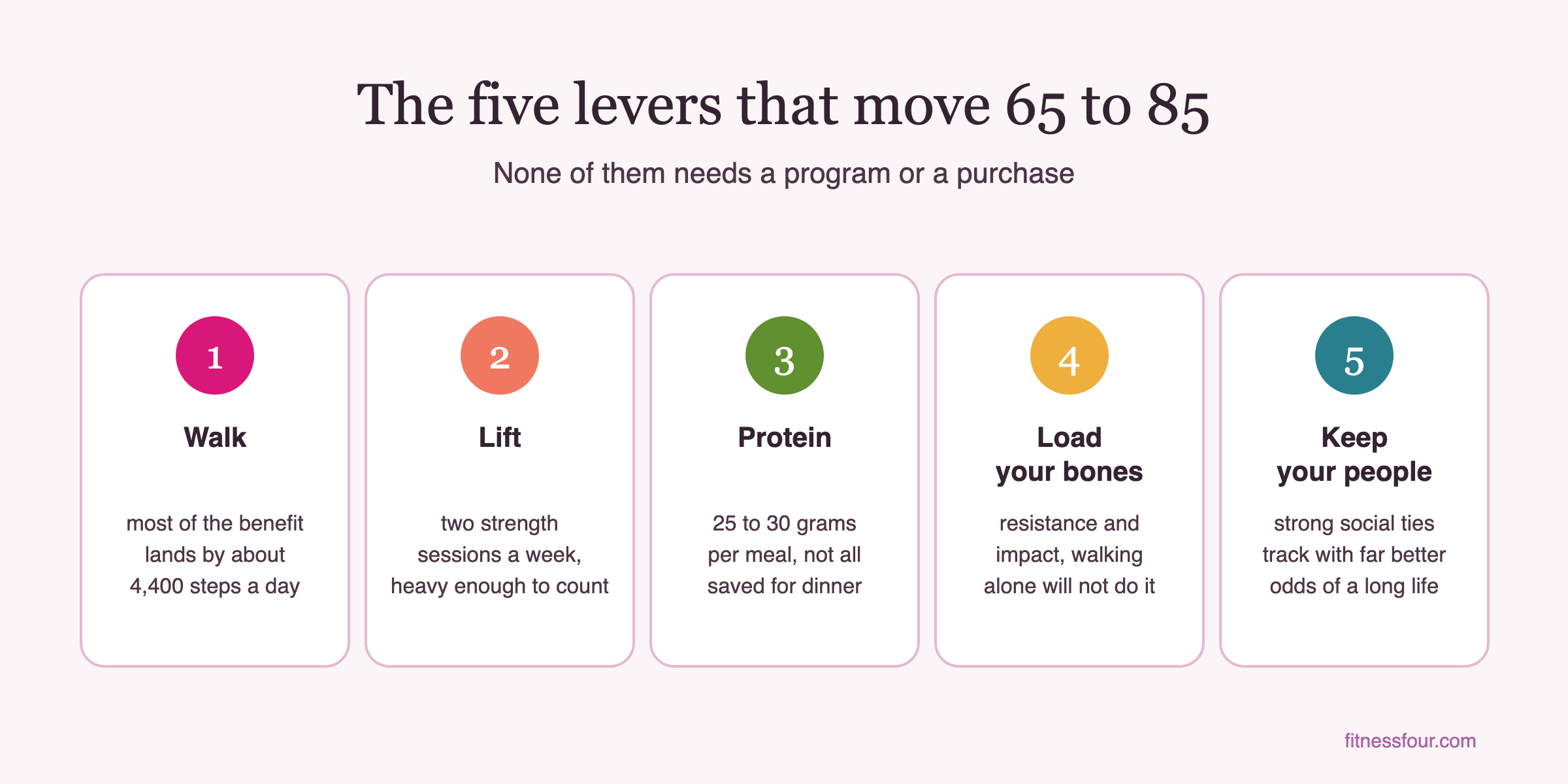
That’s what you’d probably expect when reading this. What I didn’t see coming was that there was a point where the benefits changed and also where it ended; it began showing its effect at about 4,400 steps/day (or roughly 2 miles/day), and then remained relatively flat until around 7,500 steps/day (10,000 didn’t buy anything else).
If you have spent years giving yourself a hard time over being unable to meet some arbitrary daily step goal created by a fitness company, you can now give that back as well. The distance needed to get most of the benefit is much smaller than what they sold you on and will count regardless of how long it takes you or whether you take one loop or three.
The one I resisted for years: you have to lift things now
I was the slowest to come around on this one, because I believed that strength training was something you did if you were trying to “look” a certain way in a mirror; but this is the exact opposite of true. It’s muscle loss that will steal away your independence when you’re least expecting it, and it’s the only single most reversible item on this entire list.
I know I’m going to be stuck repeating myself about studies for some time, but there’s one study (from 1990) that has continued to haunt me: Researchers took a group of frail nursing home residents who averaged 90 years of age, placed them in an eight-week strength-training program, and observed an increase in strength by an average of 174%, complete with real new muscle mass and about a 50% increase in walking speed.
Ninety years old. If at ninety years old people can create muscle mass, then the notion that sixty-eight is too late to begin building muscle mass is cancelled out entirely as well. You don’t necessarily need a gym or loaded barbells to start creating muscle; although eventually you’ll have to push the limits of each individual muscle sufficiently enough so as not to wave two pound dumbbells around while watching television news.
Two sessions per week seems like an acceptable minimum amount of research evidence indicates; whereas one review said thirty to sixty minutes of strength-building activity per week correlates with about 10 to 17 percent reduced mortality rates from all causes. That’s your total weekly dose.
Less time than I spend choosing what movie or TV show I want to watch before giving up and re-watching something I’ve already seen, and it’ll likely do more for your eighty-five year old self than probably any other single action available right now.
Protein, and why the official number is too low for us
You can easily make this piece (almost no one over 65) correct. The official protein recommendation, that.8 grams/kg body weight number you’ll find referenced, was developed many years ago and primarily tested in young males. Those researchers working with aging muscle believe this number is too low for older adults.
Older adults should shoot higher, between 1-1.2 g/kg/day body weight and even higher if you’re sick or if you’re exercising; that’s why the main gerontological nutrition organization recommends increasing your intake of protein beyond what the original recommendations suggest for most older adult populations. The recommended amounts translate into an estimated 70 to 82 grams of protein a day for a 150 pound female, rather than the about 55 grams originally suggested by the “older” numbers.
How you distribute these amounts throughout the day also matters nearly as much as how many total grams you consume each day. Aging muscle is somewhat deaf to protein signals, so it requires larger doses to elicit some level of response, about 25 to 30 grams in one sitting; so distributing your daily intake across three meals instead of consuming them all at once (dinner time) likely provides better stimulation to your muscle cells.
So, my continued advocacy about adequate protein distribution at each meal from the habits post, remains relevant today and will continue to be until it becomes habituated within our society, aiming your consumption patterns correctly during the course of a day doesn’t require eating more calories or food overall.
Bone is built by load, not by strolling
I believe that for many women, this is one of the most important things to consider after menopause, since bone loss accelerates at a time when we need to have as much healthy bone mass as possible.
I also believe that walking has many benefits for cardiovascular health, overall mood and weight, but the impact on the bone density in the spine and hips is virtually non-existent due to the fact that bone only grows or regenerates from mechanical loading (i.e. “wear and tear”) enough enough to get its attention.
This point is best demonstrated by results of an RCT called LIFTMOR (a study of about 100 post-menopausal women with moderate osteopenia/bone thinning) who received an eight-month intensive program consisting of heavy resistance and high-impact exercise two times per week.
Compared to their control counterparts, these participants experienced an increase in spinal bone mineral density of nearly three percent during that period, an improvement in their hip’s structural integrity, and surprisingly few injuries occurred despite performing very high levels of mechanical loading on those sites, likely due to supervision during each session. So, bone responds well when asked to perform a task requiring significant force/effort; conversely, it totally ignores a casual walk.
So, if there are people within your family history who have developed osteoporosis; then relying upon walking won’t be adequate to address your own risk factors for developing this condition, which provides yet another compelling rationale for picking up something heavy two times per week.
The lever that has nothing to do with your body
I can’t create an honest version of this article that excludes the single factor unrelated to physical activity at all. An enormous review pooling over 148 studies (and more than 300,000 people) concluded that having strong social ties was associated with a 50% greater probability of survival during the follow-up period, the authors put this on par with stopping smoking, and larger than obesity or sitting down for extended periods.
Fifty percent better chance of surviving due to a habit that’s free and never recorded by a fitness tracker. The time frame (65, 85) is exactly when your social calendar will begin to shrink naturally; i.e. As work ceases and friends move or fall ill; so, making sure it remains active requires conscious effort, just like it didn’t when you were forty years old.
Make a call to your friend, go through with the standing coffee even though there may be weeks where you have no desire to do so. This should be listed right next to protein and dumbbells as part of your overall health plan, not somewhere below those items in a less prominent font.
A couple of things to be pushy about with your doctor
Two things in this list are worthwhile enough to seek out before they come to you. The first is your blood pressure; a recent study, SPRINT MIND, revealed that tighter blood pressure management reduced the incidence of mild cognitive impairment (memory problems) that can occur before Dementia by about 19%.
While the SPRINT study didn’t find evidence that tight blood pressure management reduces an individual’s overall risk of developing Dementia, managing blood pressure has been shown to be one of the most effective methods available for reducing the risk of developing cognitive impairments associated with aging; so, while there may be no direct causal relationship between controlling hypertension and preventing dementia, maintaining good blood vessel health appears to be about as preventative as it gets.
The second is your hearing, of all things. A 2023 trial found that treating hearing loss slowed cognitive decline by nearly half in older adults who were already at higher risk, which is a startling return on something as fixable as a hearing aid. And a bone density scan is recommended for every woman by 65, so if you have never had one, that is a thing to bring up at your next appointment before it brings itself up the hard way.
The part that makes the whole list worth it
The objective of all this isn’t merely to add years, it’s to change the quality of those years. A recent Stanford study tracked a large number of long-term older runners over nearly two decades and showed that the active group lived about 14-16 years longer without being disabled compared to inactive groups; that’s the whole game.
It wasn’t about adding 10 or even five additional frail years toward the end, it was about pushing the onset of frailty as far back as possible, so when you’re between ages 65-85, you can live within that period upright in your own life, performing your own mulch.
And there’s evidence that suggests beginning later still has a great deal of benefit, that women who begin lifting weights at age 66 will collect much of the same benefits; so, if you’re reading this, and you think that you’ve missed your opportunity, don’t be too quick to assume that, the window is open, and remains open for an extended amount of time before someone thinks to tell us.