Strength Training After 50: The 15-Minute Beginner Plan

You can build muscle strength even after fifty. Lifting a heavy object two times a week is probably one of the most beneficial habits you can develop for your health, and yet women tend to avoid doing this more than any other habit. We walk, we stretch, we eat well, and we forget about the one habit that will determine whether you’ll be able to open your own jars and carry your own luggage at 80.

Muscle disappears without warning unless you give it a reason to stay, and the rate of muscle loss is much faster after menopause than in previous stages of life. In addition to strength, muscle also helps burn calories, maintains blood sugar storage, and acts as a shock absorber for your joints, all contributing greatly to independence in older age.
And the studies show that regardless of adult age group, from 50-year-olds through 80-year-olds, muscle responds positively to training, with women who begin lifting in their sixties and seventies showing measurable increases in strength within a couple of months. You have not missed your chance. There is no window.
You can complete the entire program in approximately fifteen minutes per session, with two dumbbells, twice a week.
The program
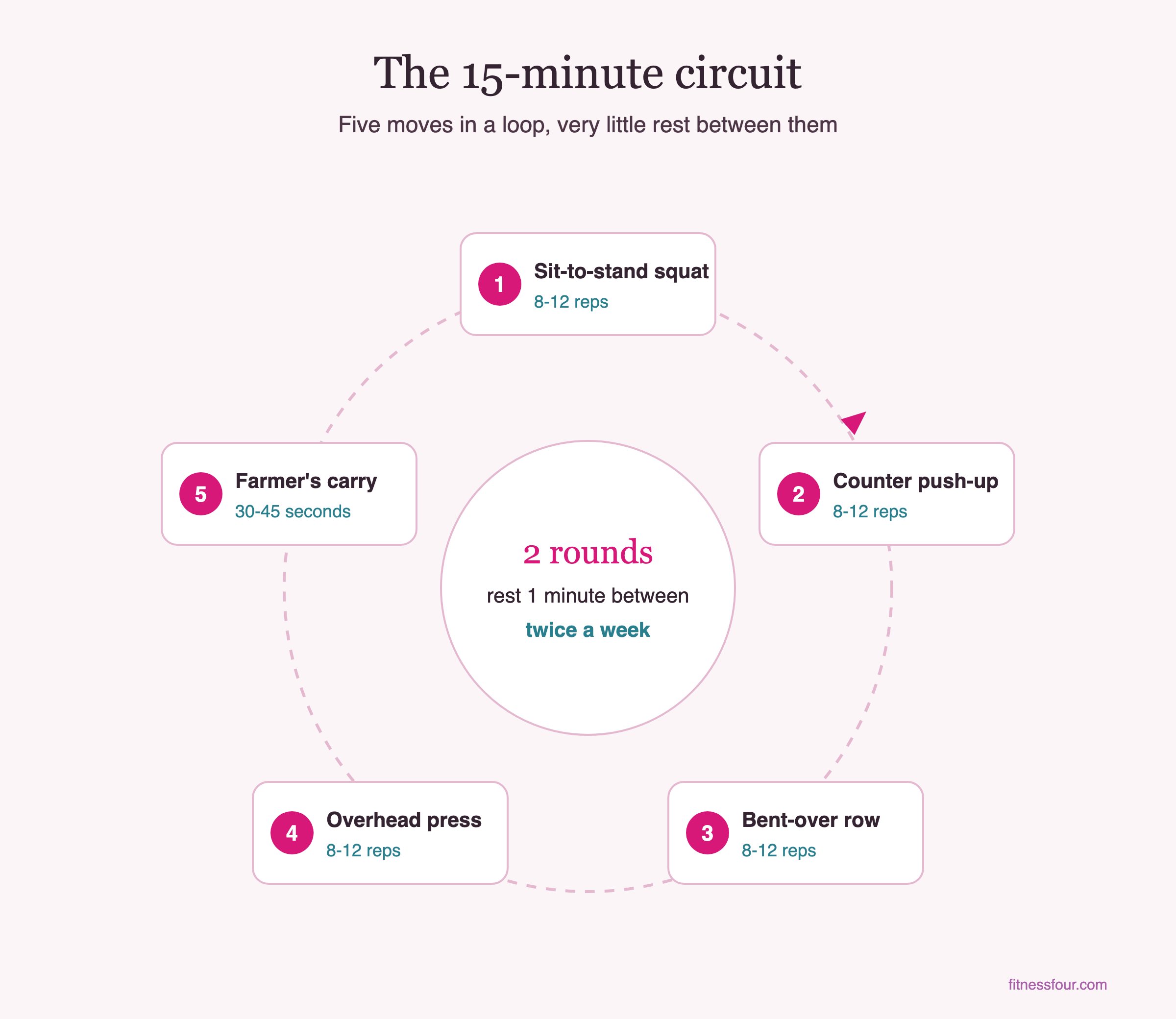
Five exercises performed as a circuit with very little rest between them: eight to twelve repetitions of each exercise, followed by resting for a minute and repeating the series once more. Two rounds completes a session, twice per week. Beginners should begin with weights that feel almost too light initially, since the first two weeks are for learning how to perform each movement rather than testing oneself.
Most beginners start with weights ranging from five to ten pounds per hand, and if you don’t have dumbbells, grocery bags or water jugs work just as well while you’re deciding whether to buy them.
| Exercise | Reps | What it protects |
|---|---|---|
| 1. Sit-to-stand (goblet squat) | 8-12 | Standing up from chairs, car seats, and the floor |
| 2. Counter push-up | 8-12 | Pushing strength for getting out of bed and stuck windows |
| 3. Bent-over row | 8-12 | The upper-back muscles that keep you upright |
| 4. Overhead press | 8-12 | Lifting to the high shelf without calling for help |
| 5. Farmer’s carry | 30-45 seconds | Grip, core, and carrying your own groceries |
1. Sit-to-stand (goblet squat)
From sitting in a sturdy chair, stand up completely without using your hands, then slowly sit back down again, taking three full seconds as you lower yourself into the chair (the slow lowering is where true strength develops).
Once you’ve found ten repetitions easy enough, simply add one dumbbell, place it against your chest with both hands, and now it’s become a goblet squat, which happens to be perhaps the most functional exercise listed here, due to its ability to simulate daily actions such as standing up from chairs, toilets, car seats, and off the ground, which happen every day of our lives.
2. Counter push-up
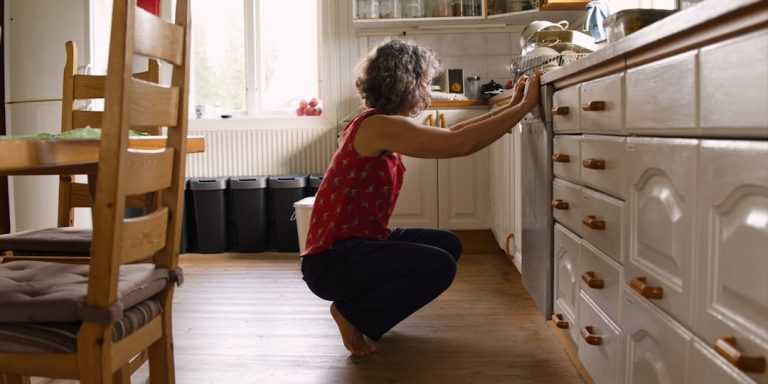
Hold onto a kitchen counter with both hands, then walk backwards until your body forms one single straight line from head to toe. Next, lower your chest towards the counter, then push back away from it while maintaining proper hip alignment. If the counter is too easy, try a lower surface such as a sturdy table.
Push-ups serve multiple purposes, including retaining proper function in the pushing muscles located throughout your chest, shoulder and upper arm areas, which enables activities such as getting out of bed, getting up from the floor, and opening stuck windows.
3. Bent-over row
Bend forward at the hips with a flat back, holding both dumbbells down towards the ground. Pull upward towards your rib cage, simultaneously squeezing your shoulder blades together, lower slowly, and repeat. Rows help you retain proper posture by developing the muscles located throughout the upper portion of your back, and those same muscles determine whether you carry yourself upright or fold over like later age invites us to do.
4. Overhead press
Holding two dumbbells positioned at shoulder height, lift upward, extending your arms completely, then lower slowly and repeat. Alternating individual arms prevents the potential strain on shoulders if lifting both simultaneously results in discomfort. Lifting overhead is one of the first functions lost before anyone realizes it has been lost, and this exercise will prevent future casserole dishes placed on higher shelves being carried by two people instead of one.
5. Farmer’s carry
Lift the heaviest pair of dumbbells possible while still maintaining proper posture, and walk in thirty-second to forty-five-second intervals, keeping your shoulders back and your core tight. Think carrying two heavy grocery bags, but exhibiting unusual dignity while doing so. It’s grip strength, core strength and shoulder stability all rolled into one exercise, and grip strength is so closely related to healthy aging that researchers use it as shorthand for overall vitality.
Two rules that make it work
First rule: increase the weight used when lifting feels too light by the last repetition of an exercise. This is the only real secret to building strength through resistance training. Women are told frequently that small weights combined with high numbers of repetitions are better suited for their needs. They aren’t! Your muscles require sufficient challenge to grow, and twenty-five repetitions of something simple provides little more than a gesture toward growth.
Second rule: provide fuel for the muscle requested. Protein works as a team member with strength training, so if you train twice weekly but eat like a bird, you’re ordering your body to build muscle with no supply available. Aim for a solid dose of protein at meals, especially breakfast, which typically proves hardest, where a high-protein smoothie makes a convenient fix.
Soreness following the initial sessions is normal and diminishes quickly as your body adapts. Sharp pain experienced during an exercise is not allowed in this program, so skip that exercise and check with your doctor if it persists. Osteoporosis or a joint replacement? Discuss this program with your doctor or physical therapist before commencing, as they’ll likely say yes and may fine-tune the list for you.
Fifteen minutes per session, twice weekly, five basic motions already practiced throughout your everyday routine, done on purpose using added weight. The woman carrying her own suitcase upstairs twenty years from now will be grateful you started this week.