7 Signs You’re Aging Well, According to Geriatricians

I have reached the age (58), where my friends and I discuss aging the way we used to discuss mortgages, which is to say constantly, with great authority, and based on almost no reliable information. Somebody’s cousin is 80 and runs marathons, somebody else’s neighbor fell apart at 62, and we trade these stories like they’re data. So I went looking for what the actual professionals watch for, the geriatricians whose entire job is telling the difference between normal aging and trouble, and it turns out they’re not squinting at your wrinkles or asking what supplements you take. They watch a short list of surprisingly ordinary things, and most of them you can check yourself, at home, today, without so much as an appointment.
Fair warning before the list: a few of these made me put down my coffee and go test myself in the hallway.
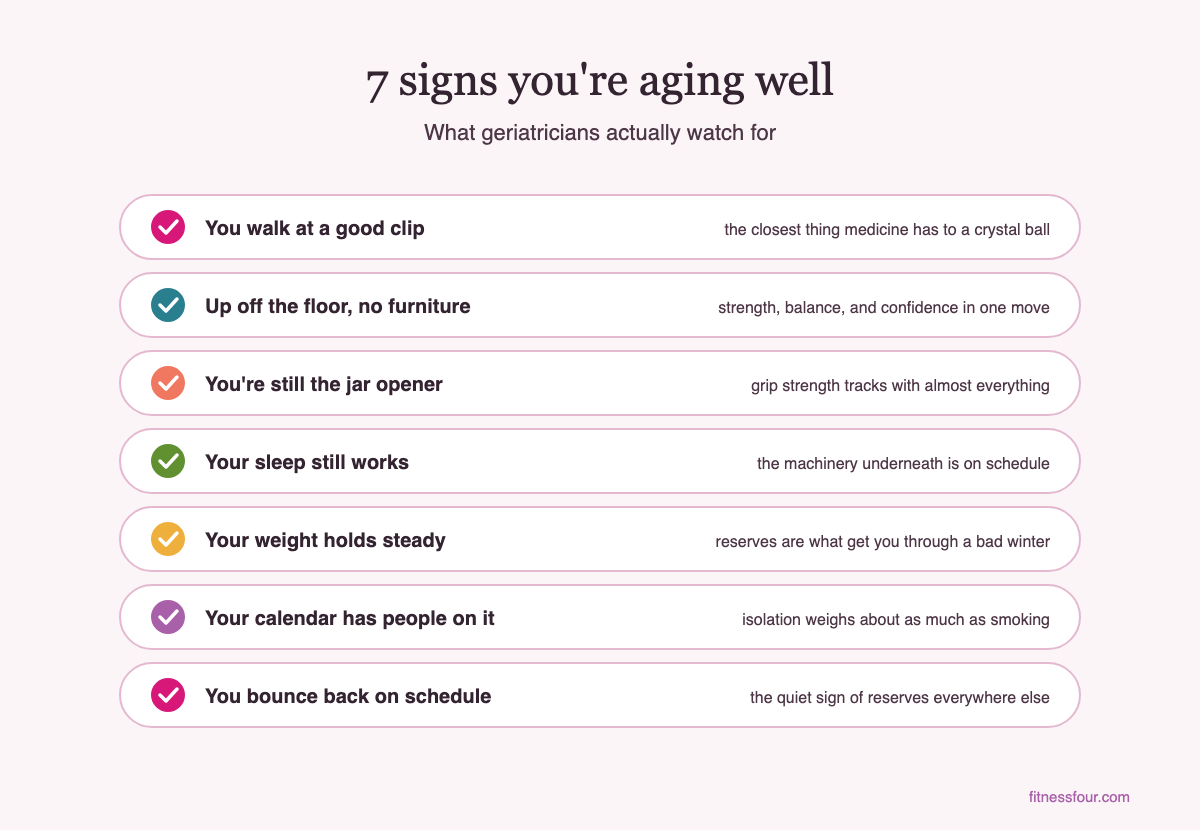
1. You walk at a good clip
Walking speed is the closest thing geriatric medicine has to a crystal ball. When researchers pooled results from tens of thousands of older adults, how fast people naturally walked predicted how long they’d live with an accuracy that startled even the researchers, and faster walkers in their 60s, 70s and 80s consistently outlived the slow ones, sometimes by years. Some clinics now time your walk as routinely as they take your blood pressure.
The reason it works is that walking looks simple and isn’t. A brisk pace requires your heart, lungs, muscles, joints, balance, and brain to all show up for work at the same time, so speed becomes a summary score for the whole system. If you’re the one your friends ask to slow down on the way to the restaurant, congratulations, that’s a better report card than most bloodwork. And you already know how I feel about walking, because I’ve been boring you with my after-dinner walk for months now. Turns out it was a medical intervention all along.
2. You can get up off the floor without a production
Down onto the floor, back up to standing, and the question is how much furniture, kneeling, and negotiating you needed along the way. Brazilian researchers turned this into a formal test years ago, scoring people on how they got down and up, docking points for every hand, knee, or elbow used for a push, and the scores tracked with how long people lived to a degree that made the test famous.
Geriatricians love this one because it bundles leg strength, flexibility, balance, and confidence into a single everyday movement, and because the floor is where the stakes are. A woman who can get herself up easily is a woman for whom a stumble is an anecdote instead of an emergency. I tested myself, obviously. I’d describe my technique as functional but unglamorous, with one knee involved, and I’ve been practicing since, because unlike my height, this is a number I can actually move.
3. You’re still the jar opener in your house
Grip strength sounds like it should only matter to arm wrestlers, but it’s one of the most studied measurements in all of aging research, and the findings are consistent to the point of being repetitive. In a huge international study following adults across 17 countries, weaker grip predicted heart trouble and earlier death better than blood pressure did. Geriatricians measure it with a little device you squeeze, but the home version works fine: stubborn jars, heavy pans, the pickle lid that visits from house to house.
Nobody thinks squeezing things is itself the magic, of course. Grip is a stand-in for how much muscle you’ve kept overall, and muscle is what decides how everything else goes, from your blood sugar to your bones to whether a bad flu takes you down for a week or a season. If you’re still the jar opener in your house, that’s not a party trick, that’s your muscle mass sending up a flare that says all’s well down here.
4. Your sleep still works
Not perfectly, because nobody at our age sleeps like they did at 25, and anyone who claims to is lying or napping in secret. But geriatricians ask about sleep at every visit for a reason, and what they want to hear is that you fall asleep within a reasonable window, stay down for most of the night, and wake up feeling like a functional person instead of a rebooting computer. Sleep that’s gone truly haywire, hours of lying awake, gasping and snoring, nodding off at red lights, is one of the earliest warning lights for a whole range of problems, from heart disease to memory trouble.
Decent sleep at this age usually means the underlying machinery, your hormones, your breathing, your brain’s daily rhythm, is still running on schedule. I’ve written a whole article about the evening routine that saved my own sleep, so I won’t repeat the sermon, but I’ll say the 3am committee meeting convenes much less often than it used to, and apparently I should be listing that on my medical chart as an achievement.
5. Your weight isn’t sliding away on its own
We spend our 40s and 50s trying to lose weight, so this one comes as a plot twist: past a certain age, geriatricians worry far more about weight you lose without trying than weight you gain. Unintentional weight loss, the kind where the scale drops and you can’t say why, is one of the flags they take most seriously, because it often means muscle is leaving, appetite is failing, or something else is going on behind the scenes that deserves a look.
A stable weight, held steady by an appetite that still shows up for dinner, means your body is holding onto its reserves, and those reserves are what get you through an illness, a surgery, a rough winter. So if your weight has been boringly consistent for years, even if it’s consistently a few pounds above where your 40-year-old self wanted it, that’s not failure. That’s ballast, and the research on people who weather health storms best says you want some.
6. Your calendar has people on it

Of everything on this list, this is the one the doctors themselves say patients least expect. Loneliness and isolation track with earlier death about as strongly as smoking does, and that finding has held up across dozens of studies and hundreds of thousands of people. Geriatricians now screen for it directly, asking who you saw this week, who you’d call at 2am, who would notice if you went quiet.
The women who age best are almost never the ones with the most impressive gym routines, they’re the ones with standing plans. The Tuesday walking friend, the book club that’s really a gossip club with assigned reading, the neighbor you trade tomatoes and complaints with. If your week has people threaded all through it, on purpose, on repeat, you’re doing a form of preventive medicine that no prescription replaces, and unlike most preventive medicine, this one comes with dessert sometimes.
7. You bounce back
The last sign isn’t a test you can run in your hallway, but you already know your own answer. When something knocks you down, a cold, a fall, a brutal week, a loss, how long until you’re back to yourself? Geriatricians have their own vocabulary for the good version of this, but what they’re actually watching is the bounce. Older adults who recover from setbacks on schedule, who get over the flu in a week instead of a month and get back on their feet after a hard season, tend to have reserves to spare across every system, physical and otherwise.
Some of that bounce is luck and genes, but a surprising amount of it is built, and it’s built out of everything above this paragraph: the muscle, the walking, the sleep, the people. Reserve capacity is the whole quiet project of aging well. You’re not exercising to look good at 60, you’re stocking a pantry you’ll cook from at 80.
4 to 5: solidly on track, and the ones you didn’t tap are your to-do list.
0 to 3: good news hiding here: every single sign on this list can be trained, scheduled, or practiced back into existence.
My completely unofficial scoring guide
Count yourself up, and be fair about it. Six or seven of these and you’re what the literature calls a successful ager and what I call annoying at reunions. Four or five, you’re solidly on track, and the ones you’re missing are worth a look precisely because most of them can be trained, borrowed, or scheduled back into existence. Fewer than that, and I’d gently point out that this list doubles as a to-do list, and that every single item on it responds to effort at any age, which is the most hopeful fact in all of aging science.
I got six of seven, if you’re wondering. I’m not telling you which one I missed, but I will say my hallway floor and I have become much better acquainted, and my grandmother would find the entire exercise ridiculous, because she aged beautifully without ever once measuring anything. She did, however, walk everywhere, sleep like a farmhand, and host cards every Thursday for forty years. The geriatricians would’ve loved her chart.