Strength Training After 50: The 15-Minute Beginner Plan

Have you ever had a moment of reflection on things you take for granted? Like zipping up a coat, lifting a suitcase into an overhead storage compartment on a plane, or twisting off the lid of a pickle jar? They’re easy to overlook until they become difficult.
You haven’t missed your chance to get stronger
After 50, maintaining functional strength—the kind that supports our independence and ability to stay active—is especially important. It also requires intentionality. Muscle mass and strength gradually wane as we get older, a decline that accelerates for women after menopause, but muscles are critical for burning calories, storing glucose, supporting joints, and more. The good news: muscles are responsive to training, no matter your age. Women who start lifting weights in their sixties and seventies can build strength. Your muscles still respond to resistance training in your eighties.
Lifting light weights, even just five to 10 pounds, consistently, just twice per week, has the power to make an amazing difference in your strength and functionality. It’s never too late to start.
The 15-minute plan
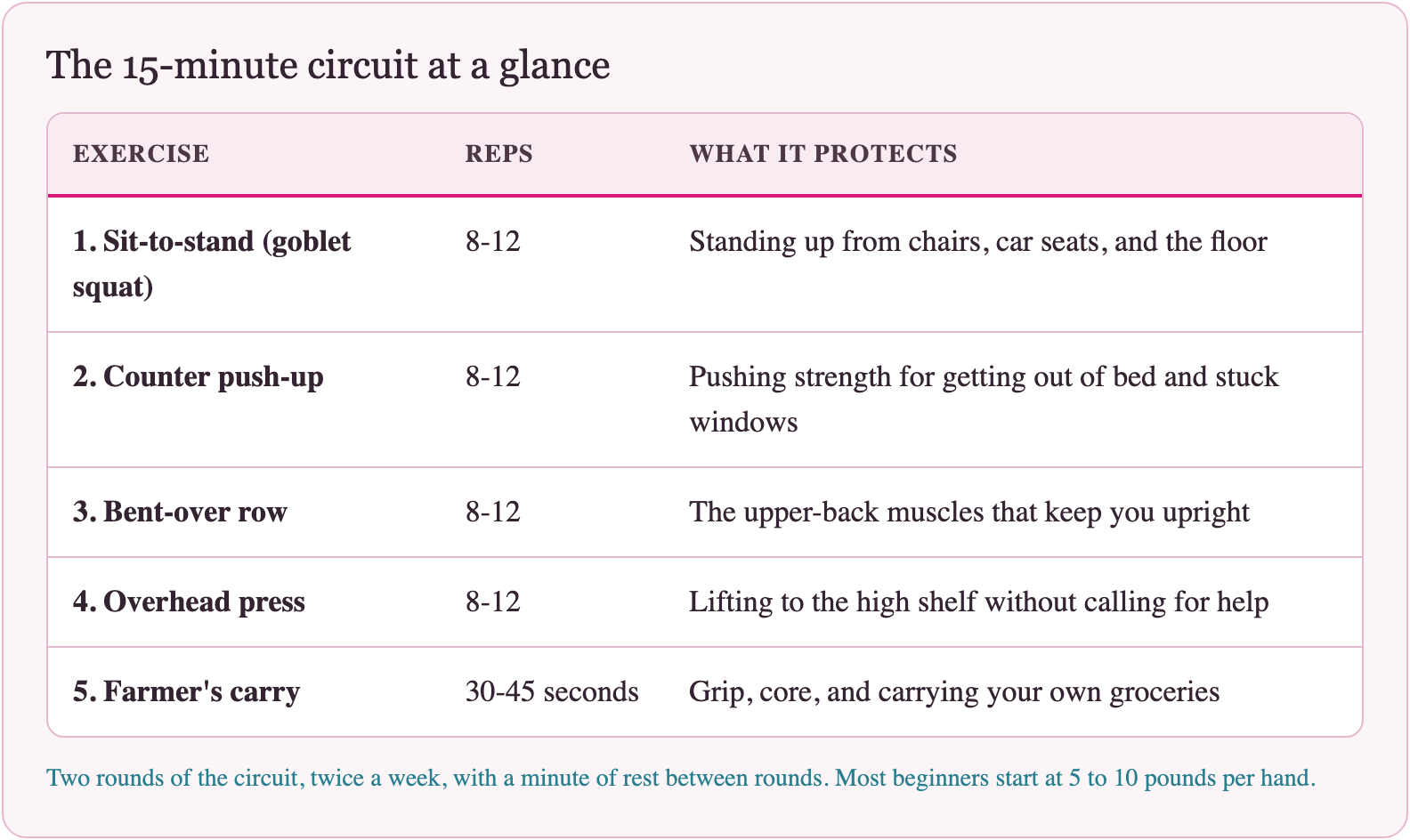
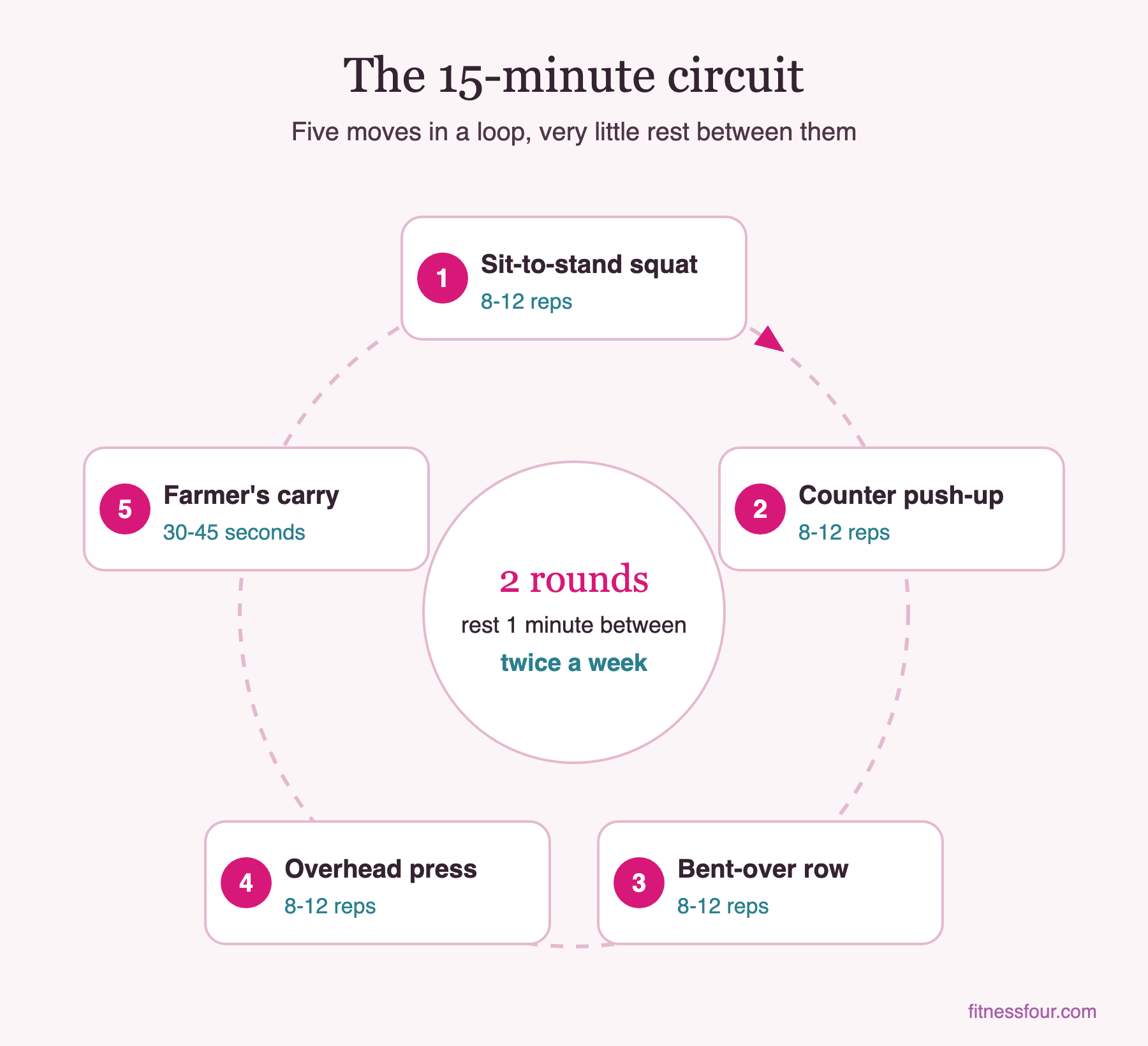
Do this circuit of exercises twice per week, for a total of 30 minutes of resistance-training per week. Perform each exercise in succession. Do two rounds of the circuit with a one-minute rest in between rounds. Perform eight to 12 reps of the first four exercises. Start out using a weight that feels very manageable for the first couple of weeks, then work on increasing the challenge. For example, grab two five-pound dumbbells or two gallon-size jugs of water or two large grocery bags filled with items that total about five to 10 pounds. Perform the farmer’s carry for time, rather than reps by walking for 30 to 45 seconds, keeping your shoulders down and avoiding leaning to one side.
You’ll need a sturdy chair and a counter.
1. Sit-to-stand
Do 8–12 repetitions.
Stand in front of a sturdy chair with your arms crossed over your chest. Keeping your chest lifted, sit back down by bending at the hips and knees, taking a count of three to sit down. Then, squeeze your glutes and drive through the entire foot to stand up, making sure to extend the knees fully at the end. That’s one rep. Continue for eight to 12 reps. When you can easily do 10 of these, grab a dumbbell, hold it to your chest, and perform the goblet squat variation. This exercise strengthens the entire lower body. Being able to do this exercise well translates to being able to get up and down off of a toilet, couch, etc.
2. Counter push-up
Do 8–12 repetitions.
Standing a couple of feet away from a counter, place your hands on the counter and lean your body forward. Keeping a straight line from head-to-heel, bend at the elbows to lower your chest toward the counter, then straighten the elbows to press away from the counter. That’s one rep. Perform eight to 12 reps. When this gets too easy, move to a lower surface such as a sturdy table. This works the muscles of the arms, chest, and shoulders.
3. Bent-over row
Do 8–12 repetitions.
Standing with a dumbbell in each hand, bend at the hips, reaching your hands toward the floor. Keep your back flat (don’t round it!) and shoulders away from your ears. Bend at the elbows to lift the dumbbells up to your ribcage, then lower back down with control. That’s one rep. Continue for eight to 12 reps. This exercise works the upper-back muscles that support good posture.
4. Overhead press
Do 8–12 repetitions.
Starting with dumbbells at shoulder-height, press them up and over your head. Lower back down to shoulder-height. That’s one rep. Continue for eight to 12 reps. When this gets too easy, increase the amount of weight you’re pressing. This exercise strengthens the shoulders, making it easier to reach for items on high shelves. If needed, do this exercise by pressing one dumbbell at a time.
5. Farmer’s carry
Walk for 30–45 seconds.
Grab two heavy but manageable dumbbells. Keeping your shoulders down and avoiding leaning to one side, walk for 30 to 45 seconds. Then rest for one minute before starting your second round. This exercise strengthens grip, shoulders, and the core, making it easier to carry purses, grocery bags, and more.
Two habits that help you make progress
Increase the weight when the exercise gets too easy.
As you get stronger, increase the amount of weight you’re lifting or perform more challenging variations of these moves. It’s important to continue challenging your muscles, as they’ll only get stronger if you make it hard enough for them to have to adapt. When it’s easy for you to do 12 reps, increase the weight.
Give your muscles enough fuel.
Make sure you’re getting enough protein to repair and build muscle. Include protein-rich foods regularly at meals, particularly at breakfast or have a protein-filled smoothie if you’re not hungry.
Know the difference between soreness and pain
Discomfort is OK; pain is not. It’s normal to feel a bit achy after strength-training, which means your body is adapting to get stronger; stop an exercise if you feel any sharp or unusual pains. Talk to your doctor or physical therapist if you’ve had a joint replacement or have osteoporosis, as they may suggest modifications.
A small commitment worth making
A 2022 meta-analysis published in the British Journal of Sports Medicine found that any amount of strength training was linked to 10–17% lower all-cause mortality, with the biggest benefit seen at around 30 to 60 minutes a week.
It may feel silly at first to be lifting such light weights, but soon, you’ll be surprised how challenging this circuit can be. Give it a try. And remember: It’s never too late to reap the rewards of building strength.
How to choose your starting weight
Do all twelve reps and if the last couple were tough but you know that you could get 2 more done, you’re golden. If you’re breezing through them and know you could continue on to twenty reps, pick a weight that’s a bit heavier. If you’re falling apart before you make it to rep 8, pick a lighter weight.
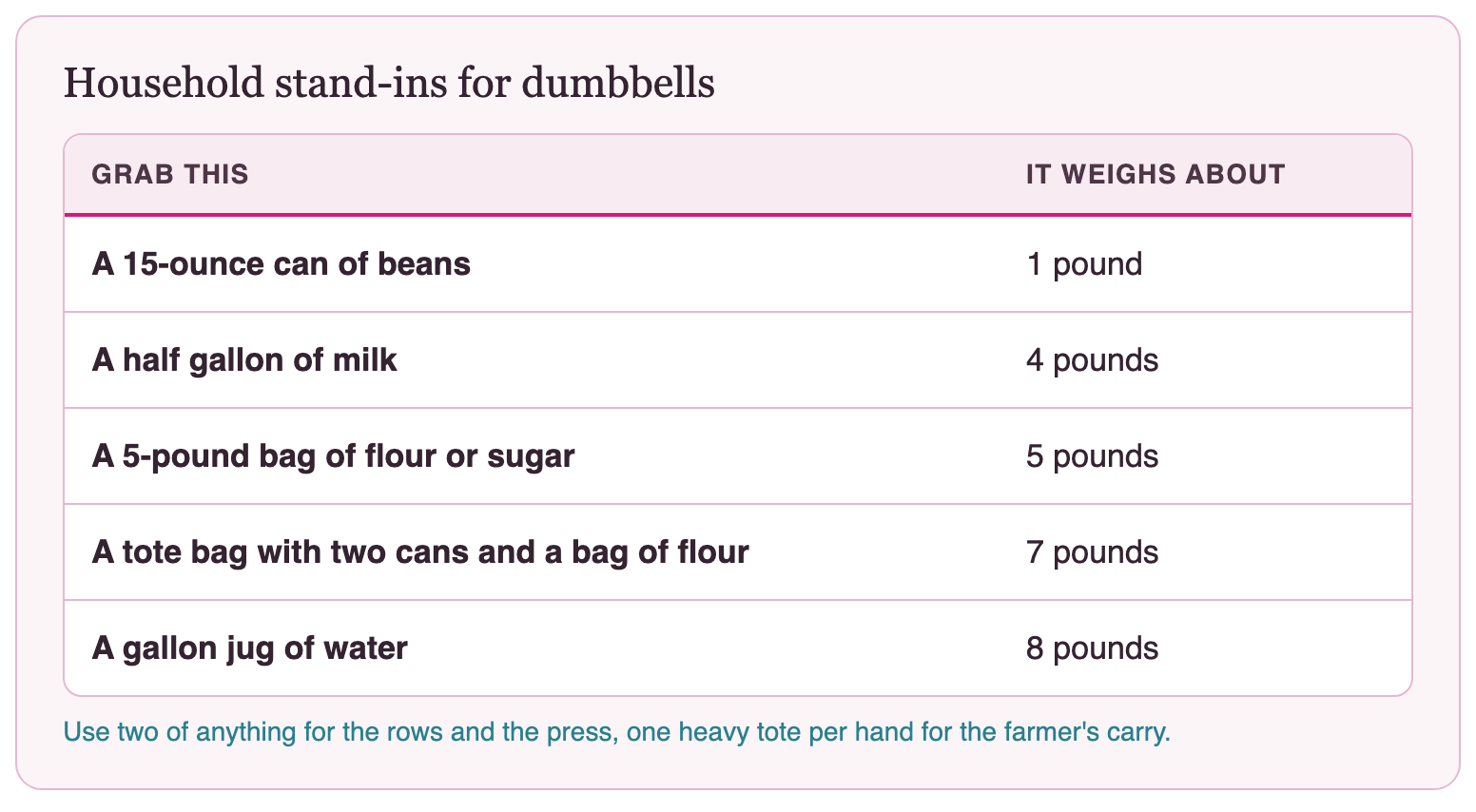
If you’re a woman and are brand-new to lifting weights, odds are good that one pair each of 5 and 10 pound dumbbells will take you a long ways, or an adjustable set. Different exercises require heavier/lighter weights, as overhead presses call for a “lighter” weight, while rows and carries call for a heavier one, so it’s best to have a range of weights to choose from.
You can always invest in more/adjusted dumbbells down the road. No dumbbells yet? You can use lots of items around the house as weights. A gallon of water weighs just over 8 lbs., a half-gallon of milk is about 4 lbs., a bag of flour might be 5 lbs., a 15 oz. can of beans is about 1 lb. Use your creativity.
How to track your progress
I suggest jotting down your starting weights, recording them in subsequent workouts, and tracking progressions as you make them. Some people like to have a place to track this information where it’s easy to view; others jot things down on whatever piece of scrap paper is closest. Choose what works for you. Some people like to create a fancy graph or chart; others like my solution of taping a sheet to the refrigerator and checking off workouts. Choose what works for you.
What to expect in your workouts
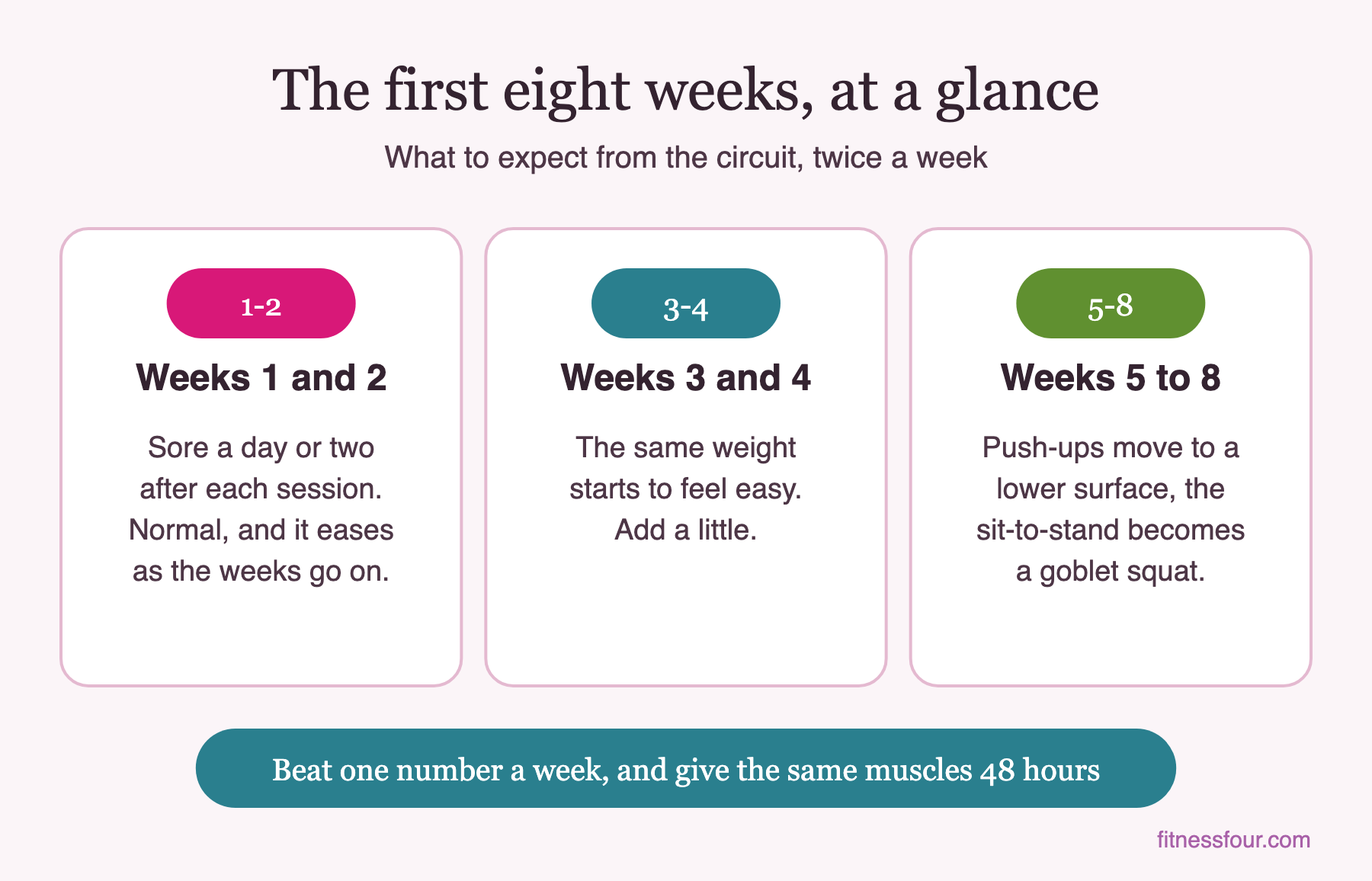
You will be sore. Odds are, you’ll be sore the day after the first workout, sorest around day 2, and the soreness will lessen as your body adjusts to the new activity. Don’t forget to schedule these workouts twice per week, and allow about 48 hours between workouts for your muscles to recover. Muscle growth happens when we’re resting/recovering, not during the workout.
This routine follows national guidelines for physical activity, which call for muscle-strengthening activities on at least two days per week, in addition to 150 minutes of moderate intensity physical activity spread across the week. Some people choose Monday and Thursday workouts, and if you ever add a third day, Monday, Wednesday and Friday keeps the gaps. Try to avoid choosing Monday/Tuesday, as back-to-back days are not suggested.
What to expect as your body changes
You will gain strength. In the first couple of workouts, your body is sore and feels wobbly lifting those weights. By week three/four you’ll be lifting those same weights and they’ll feel easier. This isn’t mainly because of muscle growth, which takes a couple of months of consistent strength training to become noticeable, it’s because your body is learning to use the muscles more efficiently.
Weeks five/eight: Your body has been doing this routine for five to eight weeks, and is becoming efficient. The counter-assisted push-up position that felt precarious is starting to feel stable, so it’s time to find a lower option. Sit-to-Stands are feeling a bit boring, so it’s time to graduate to goblet squats. Your muscles are changing, but those changes probably won’t be aesthetically obvious yet.
You’ll almost certainly be lifting more than you started with, but other areas of life have started to feel easier. Stairs don’t leave you huffing and puffing. You can carry all of the grocery bags into the house, then unpack them. These are the gems that remind us of why we started working out in the first place.
Progression
Don’t expect to see changes in your body right away. However, after just eight weeks of implementing these fifteen-minute, twice-a-week workouts, you will be able to see changes in how you feel and move. Try to challenge yourself to add more to your workout each week. Just one thing. For example, do one more push-up, add five seconds to the farmer’s carry, or a little weight to the grocery tote in the bent-over row.
Make a scoreboard. I’m not tech-savvy enough to recommend an app, so make a simple chart to post on your fridge with the following headings: day, weights, reps, etc. Then add a second scoreboard to keep track of your accomplishments. Can you pick yourself up off the floor? Can you pack the overhead bin at the airport? Can you carry all of the groceries into the house in one trip?
Can you open that jar that’s been giving you grief? These accomplishments will be a result of implementing this workout.
Days off are active-recovery days: Go for a walk, bike, tend the garden, do Pilates moves against the wall; whatever gets your body moving so you’re not so tight the next time you implement these exercises. Do not work the same muscle groups really hard on two consecutive days.
If you’re feeling more fatigued than usual, are still sore after a whole week, aren’t sleeping as well as normal, or the same weights seem heavy, scale back the weight, or skip that week’s progression, until your body is ready for more. Don’t push through that feeling.
Tips for success
Be sure to warm up. You’ll be surprised how much easier your muscles and tendons will tolerate these exercises after just three minutes of preparation. March in place swinging your arms for one minute. Circle your arms ten times in both directions. Do five Sit-To-Stands without any weight. Do five Counter Push-ups but don’t come all the way down. No stretching at this time, as you save that for when you’re nice and warm.
Don’t make these common mistakes:
Holding your breath: exhale on effort, for example as you stand back up in sit-to-stands, press away from the counter in counter push-ups, press upward in the overhead press, or pull weights toward your torso in the bent-over row. Holding your breath will increase your blood pressure.
Rounding your back during the bent-over row: use a counter for support with one hand, do this exercise with just one arm at a time.
Shrugging your shoulders in the overhead press: make sure your shoulders stay down. If they’re shrugged, you’ll be lifting the weight with your neck.
Allowing your knees to cave in on sit-to-stands: make a point to push them out over your toes.
Letting weights or your body come down too quickly: take three counts to lower in all of these exercises.
When to talk to your doctor first
If you have high blood pressure that’s not well-controlled, a heart condition, or have recently had surgery, speak with your doctor before beginning this program to see if there are modifications you should make. Don’t continue these exercises if you feel pain in your chest, dizzy, or a sharp pain inside a joint. Speak with your doctor.