
Why January Fails Women Over 50 (And What Works Instead)


Every December, millions of people make the same promise to themselves: This is my year. They make a vision board, take out a gym membership, set their alarms for five a.m., all ready to achieve their New Year’s Resolutions.
For most people, this energy lasts until the second Friday of every January — the day Strava’s activity data has dubbed “Quitters Day,” as this is when most resolvers’ activity drops off.
It’s tempting to say that this happens because we lack discipline. A more complicated but accurate explanation could be that the standard New Year’s resolution model was never particularly well-suited for anyone. Women over 50, in particular, might find that the timing doesn’t work well for this stage of their life.
Here’s why — and what to do instead.
Why Are We So Obsessed With January 1st?
January 1st feels like the natural place to start if you want to make a big change.
In a 2014 study, Wharton researchers explored what’s called the “Fresh Start Effect.” They tracked Google searches for “diet,” gym check-ins, and formal goal commitments, and found they all spike after what they called temporal landmarks: the start of a birthday, a new week, new month, or new year.
The researchers theorized that these markers let people mentally “file” their past selves away, giving them motivation to embark on ambitious new goals.
This, plus the “new year, new me” energy you might be surrounded by at this time of the year, explains why we feel motivated to make resolutions for January. But that doesn’t mean we actually have the capacity to follow through on our intentions.
You’re Probably Entering January Sleep Deprived
Does anyone really feel well-rested on January 1st?

We’re just coming off the holiday season. Late nights, disrupted routines, and increased alcohol consumption means most of us have lost a lot of sleep by the time the new year rolls around.
For women over 50, this can be a major issue, as the perimenopausal period already means you’re likely missing out on quality sleep. Between 40% and 60% of women report sleep disruption during the menopause transition, with hormone-driven night waking and hot flashes being a major culprit.
Sleep loss wears down the same mental resources — attention, impulse control, the ability to override an old habit with a new one — that you’ll need to follow through on your six a.m. gym plans.
It also messes with the hormones that control hunger: in a 2023 study, just one night of total sleep deprivation was enough to lower leptin (the hormone that tells your brain you’re full) and raise ghrelin (the hormone that tells you you’re hungry). This shift can leave you hungrier and more prone to cravings than usual.
The Holidays Can Be Pretty Exhausting for Women
There’s another, more nuanced, reason why women over 50 might find themselves particularly burnt-out at the end of December.
The holidays can be depleting. Celebrations, travel plans, and hosting family requires a great deal of mental and physical work. In many families, this falls to women.

If you’re currently middle-aged, you might find yourself a member of the “sandwich generation.” According to AARP’s 2025 Caregiving in the US report, 29% of family caregivers are simultaneously caring for children and adults — a figure that climbs to 47% among caregivers under 50 — and three in five caregivers overall are women.
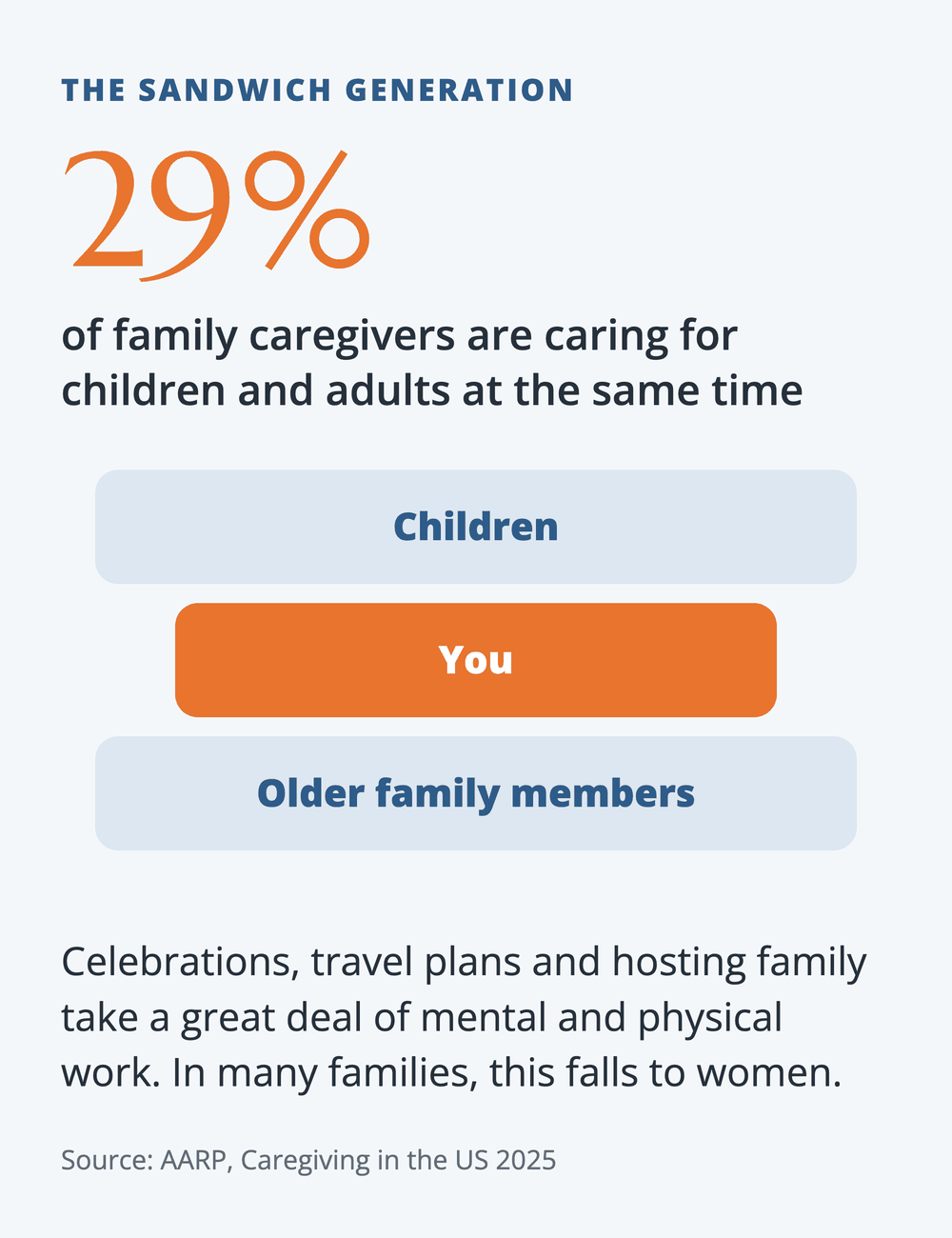
The stress often ramps up during the holidays, with many women feeling compelled to make the holidays magical for their kids while caring for older family members.
If you’re in this situation, you might find yourself craving a holiday after your holiday — one where you actually get to sleep in, not juggle dozens of commitments, lists, and chores.
So, What Actually Works?
If New Year’s Resolutions seldom work for you, fret not. You can still achieve your goals and add new habits to your lifestyle. You likely just need a different approach.
Consider January a trial run
If you want to capitalize on that new year energy but need time to decompress after the holidays, try thinking of January as a trial period.
Take January to recover from the holidays, carefully think about your goals (without holiday stress interfering with your true intentions), and test out a few habits before fully committing to a plan. Let yourself make mistakes — that’s what a trial period is for!
Instead of fixating on the first day of the new year, treat February 1st as your “fresh start” day. This relieves a bit of the pressure and gives you a buffer between the chaos of the holidays and the start of your new habits.
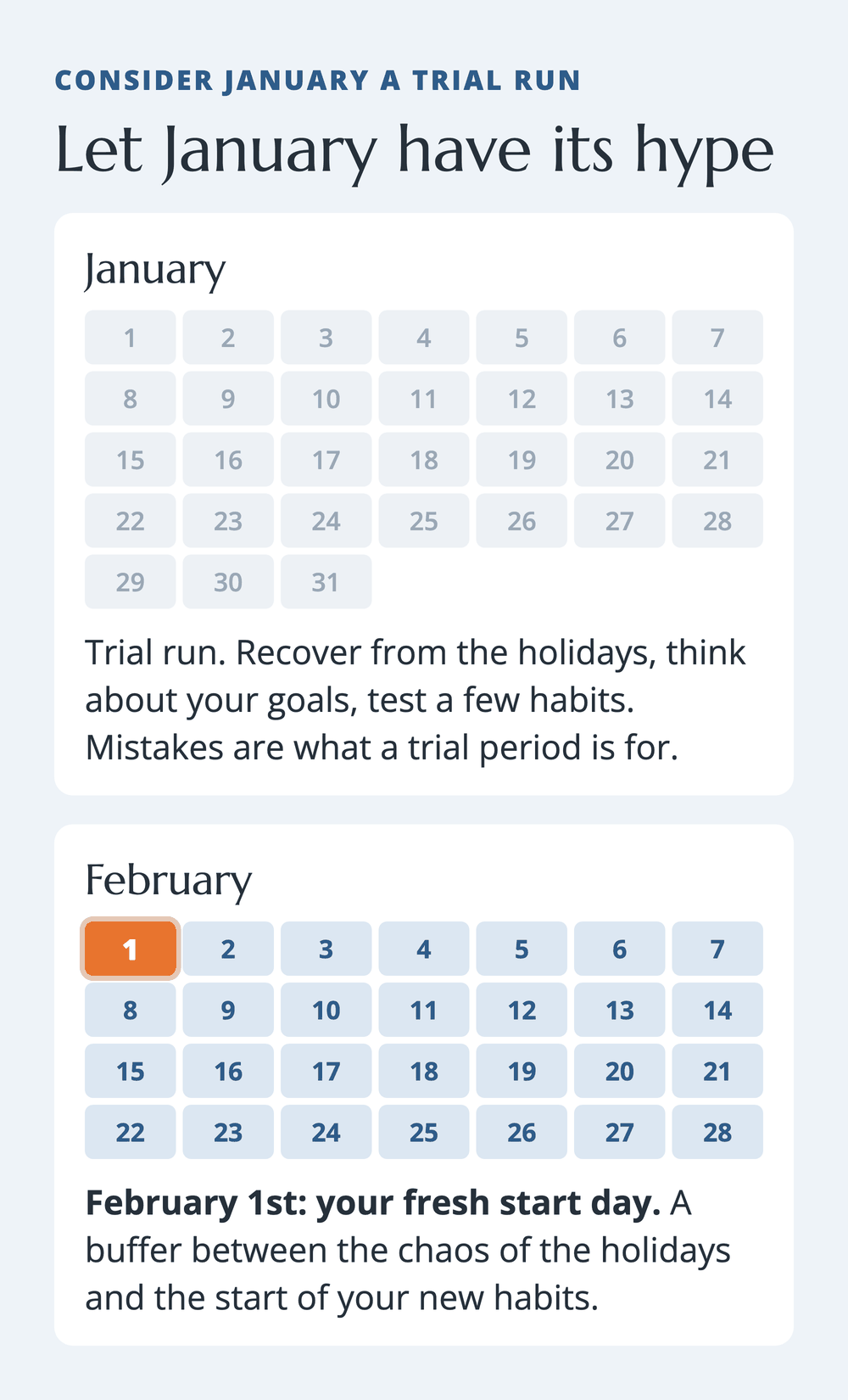
Remember, the Fresh Start Effect isn’t specific to January 1st. Any meaningful time marker — a Monday, a birthday, the start of the school year, the beginning of a new month — can feel like a fresh start, especially if you treat it like it is.
Give it more time than you expect
It takes 21 days to build a habit, right? Not quite.
Plenty of research suggests that it takes longer for a new habit to feel “natural,” so if you’re still struggling with motivation after day 22, keep at it.
In one study, researchers found that it took a median of 66 days for a new habit to become automatic. But they also found that there’s no fixed time frame that applies to everyone. It depended on the behavior and the person.
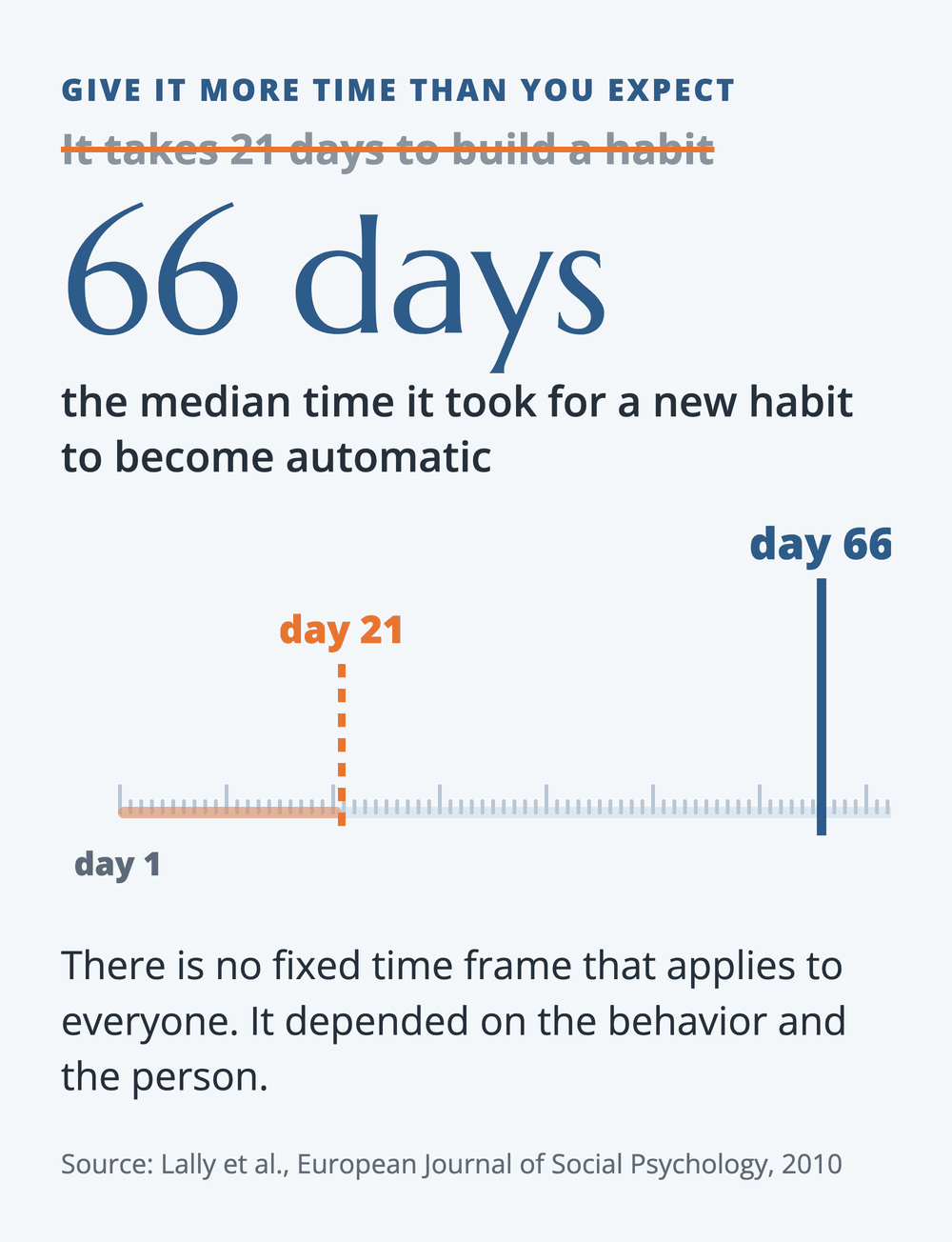
Some habits are easier to form than others. Keep this in mind when trying to build a new one. Don’t assume you’re doing it wrong just because it still feels tough after a month — give yourself grace (and plenty of time).
Write the specific “if-then” plan
Implementation intentions can make a huge difference in helping you reach your goal. These are plans along the lines of, “If situation Y is encountered, then I will initiate goal‐directed behavior X” or “I will do X action at Y time in location Z.”
A large meta-analysis, covering 94 separate studies, found that implementation intentions had a “medium-to-large” effect on helping people reach their goals. Research also suggests that writing these down, not just thinking about them, can make a huge difference.
In other words, you imagine a specific situation and the behavior you’ll do in that situation. For example:
- “When I wake up, I will make my bed before having my first cup of coffee.”
- “If I’m waiting for the coffee machine, I will do 20 calf raises in my kitchen.”
- “If it’s Sunday at 5pm, I will go on a walk with my spouse.”
This approach can also be helpful for figuring out what to do when you’re not in the best space. Bad sleep, caregiving demands, and health issues can all get in the way of your intentions — so considering what you’ll do in those situations can be helpful.
For example:
- “If I wake up late and don’t have time to meditate for 10 minutes, I’ll do a 2-minute meditation on my commute.”
- “If I’m looking after an ill child or parent and I can’t manage to cook a healthy dinner, I can order takeout — but only a healthy dinner from this specific place.”
- “If it’s raining and I can’t go for my daily walk, I’ll do a 20-minute YouTube workout.”
The idea is that you have a contingency plan. Instead of throwing in the towel or skipping your habit altogether, you have a slightly easier version.
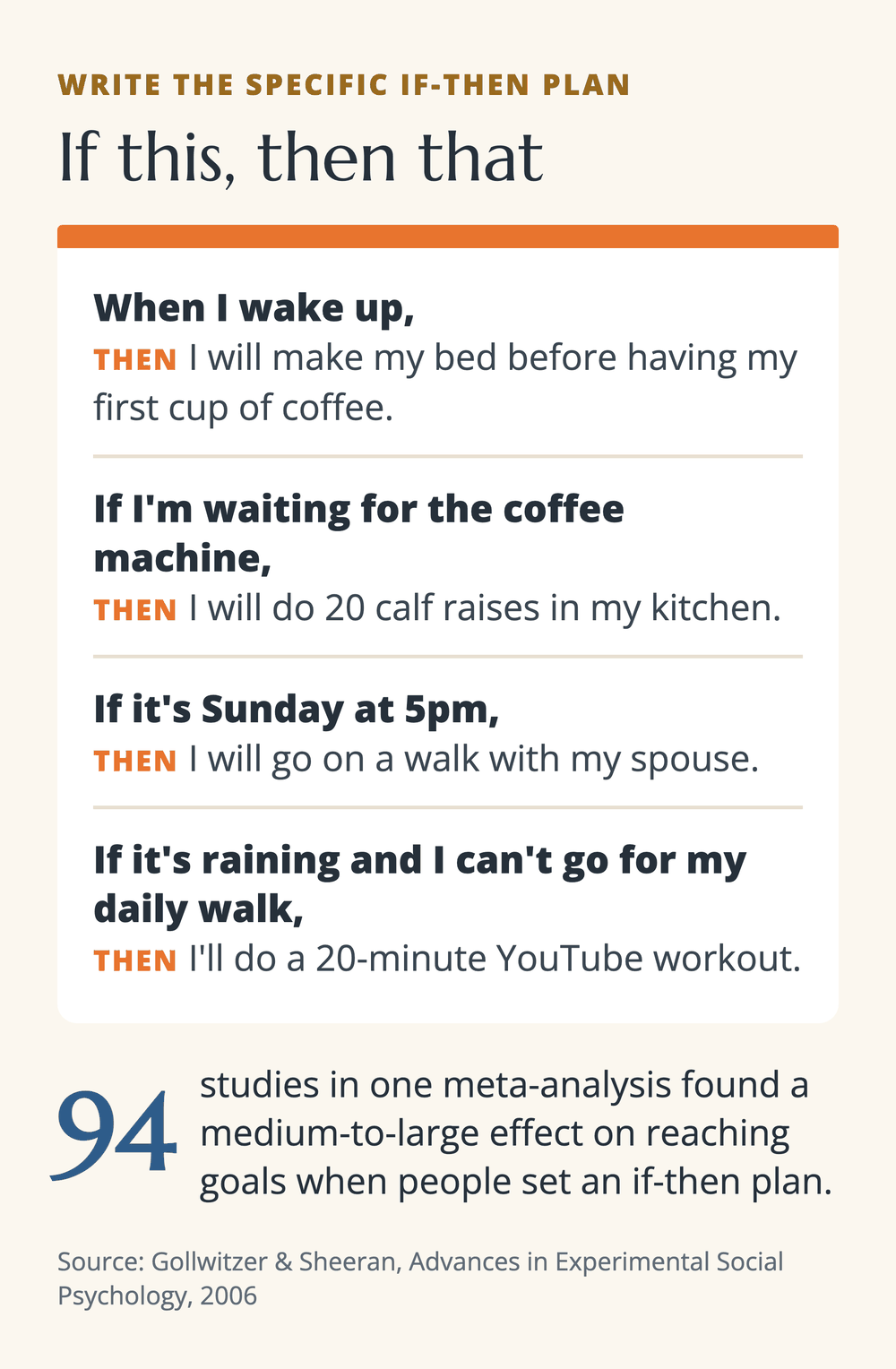
Another tip is to write these “if-then” plans down. In one study, participants who wrote a concrete if-then were three times more likely to reach a difficult goal.
Ask yourself why you actually want this
Plenty of research has shown that we’re more likely to reach goals that mean something to us on a personal level. This is called self-determination theory.
Let’s say you’ve decided to go on a walk every day because it sounds like a good resolution or because you feel like you should. You’re more likely to actually achieve that goal if you have a more personal connection to it — for example, because you know it’s essential for your mental health.

So, if you’re setting a goal because it sounds good, or because your doctor or partner told you to, dig a little deeper. Is it something you really want? Why? Understanding this can help you actually reach your goal.
Your Fresh Start Doesn’t Need To Be In January
One of the biggest goal-setting mistakes we can make is to forget what our lives actually look like when you set those goals.
You can’t create a plan built for someone with an empty calendar, a full night’s sleep, and nobody else’s needs on her list. That person doesn’t exist. Certainly not in January.

So let January have its hype. Your fresh start doesn’t have to start there — it can land in February, on a random Tuesday, or the first morning in weeks you wake up without an alarm. The important thing is to consider what actually works for you, not a fantasy version of yourself that has infinite energy and zero commitments.