8 Habits for Better Sleep As You Get Older

Somewhere in my mid 50s, sleep and I renegotiated our contract without my consent. I used to be someone who slept the way other people described sleeping, head on pillow, eight hours, done, and then gradually I became someone who woke at 3am for committee meetings on topics like “that thing you said in 2009” and “do we hear dripping.” I’ve written before about the evening routine that got me most of the way back, but that piece was about my particular evening, and today I want to zoom out to the bigger list, the habits that the sleep research keeps pointing at for people our age specifically.
Because here’s the thing nobody tells you: sleep changes after 50 for real, physical reasons. It’s not a character flaw. Our brains produce melatonin earlier in the evening and less of it, slow-wave sleep, the stage that does the repair work, shrinks, and the whole system gets easier to knock off course, which means the sloppy sleep habits we got away with at 35 finally start sending invoices. The good news is the same research is clear that older sleepers respond beautifully to habit changes, often better than younger insomniacs do. These are the eight with the best evidence behind them.
1. Get up at the same time every day, yes, weekends too
If you take one habit from this whole article, take this one, because it’s the anchor the other seven tie up to. Your body clock decides when to release the sleepy hormones at night based mostly on when it saw you wake up that morning, so a wake time that bounces around by two hours is like resetting a wristwatch twice a week and wondering why it’s never right.
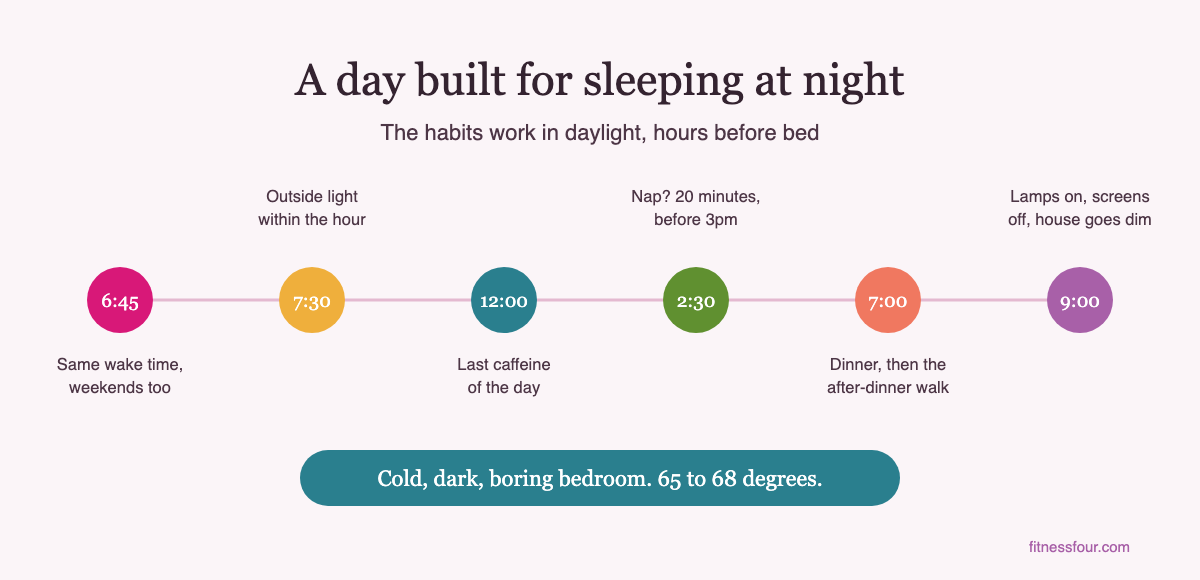
A fixed wake time, held steady for a few weeks, does more to consolidate broken sleep than almost any purchase or pill, and sleep clinics build their entire programs around it. Mine is 6:45, chosen by the dog and ratified by me, and I’ll admit the first two weeks of honoring it on Sundays felt like a punishment. Then my nights started knitting themselves back together, and now I guard that wake time like it’s a family recipe.
2. Go outside within an hour of waking
Morning light is the strongest signal your body clock gets all day, and it becomes more important with age, not less, because our eyes literally let in less light as we get older and the clock runs on dimmer information. Ten or fifteen minutes of real outdoor light soon after waking, no sunglasses, tells your brain in its own language that the day has officially started, which is precisely what lets it schedule sleepiness on time that night.
Indoor light doesn’t cut it, and this surprised me, because even a bright kitchen delivers a small fraction of what an overcast sky does. My version is coffee on the back step, or the first loop of the dog walk, and on truly miserable mornings, standing at an open door like a lighthouse keeper checking the weather. It counts.
3. Land your last caffeine by noon
Caffeine has a half-life of five to six hours, which means close to half of the 3pm coffee is still circulating at 9 or 10 that night, sitting in your brain and blocking the very chemical that builds sleep pressure all day. And to pile on, we metabolize caffeine more slowly as we age, so the afternoon cup we handled fine at 40 has become, chemically speaking, a stronger and longer drug at 60.
The cruel part is that caffeine doesn’t necessarily stop you falling asleep, it just shaves down the restorative stages while you’re under, so you can sleep eight hours and wake up feeling like you got cheated, and never think to blame the innocent little 2pm latte. Noon is my personal cutoff, and moving it there from mid-afternoon was, for me, worth more than the fancy pillow, the weighted blanket, and the sleepy-time teas combined.
4. Rethink the nightcap
I know. I’m sorry. Wine feels like it helps, and that feeling isn’t a lie exactly, because alcohol does relax you toward sleep faster. Then it turns on you at 2am, because as your body finishes processing it, your nervous system rebounds into a lighter, more fragmented mode, and that’s frequently the hidden author of the wide-awake-at-3am chapter. Alcohol also cuts into slow-wave sleep and worsens snoring and overheating, and our sleep at this age has less slack to absorb all that than it used to.
Nobody’s asking you to resign from pleasure. The workable version most sleep doctors suggest is earlier and less, finishing any drink three or so hours before bed, and noticing what your night does on the nights you skip it entirely. I did that experiment reluctantly and the results were rude in their clarity.
5. Keep naps short and early
Napping isn’t a failure, whatever our mothers implied, and for older adults a brief nap can rescue the afternoon. The trouble starts with length and timing. Sleep works on pressure, building all day like appetite before dinner, and a long late nap is a bag of chips at 5pm, taking the edge off exactly the hunger you needed for the main event.
The formula from the research is short and early: around 20 minutes, before 3pm, sitting up or somewhere you won’t accidentally go under for two hours. Set a timer and treat it like an espresso in nap form. If nighttime sleep is really struggling, it can be worth skipping naps entirely for a couple of weeks while the fixed wake time does its knitting, then adding the short nap back once nights are solid.
6. Move every day, and finish the sweaty stuff early
Exercise is one of the most reliable sleep treatments ever studied in older adults, helping people fall asleep faster and sleep more solidly once they’re down, and it doesn’t take much. Regular walking alone moves the needle in study after study, and strength training seems to help slow-wave sleep specifically, which is exactly the stage age has been stealing from us.
Timing matters a little, though less than people fear. A hard, heart-pounding workout right before bed raises your core temperature and revs your system at the wrong moment, so the vigorous stuff sleeps best in the morning or afternoon. Gentle evening movement is a different story, and my after-dinner walk, which regular readers are tired of hearing about, is fine for sleep and possibly the point of my whole day. Stretching or easy yoga before bed also lands on the helpful side of the ledger.
7. Make the bedroom cold, dark, and boring
Your body needs to drop its core temperature a degree or two to get into its best sleep, and it does that by radiating heat out through your skin, which it can’t do in a warm room under a mound of bedding. Sleep researchers keep landing on 65 to 68 degrees as the zone, cooler than most houses run, and the fix is a cracked window, a fan, or finally winning the thermostat negotiation.
Dark matters just as much, because even modest light in the room at night has been linked in older adults to worse sleep and a few other things you don’t want. Blackout curtains or a soft eye mask, streetlight handled, done. And boring is the underrated third leg: the bedroom works best when your brain files it under sleep and nothing else, so the television, the bills, and ideally the phone all sleep in other rooms. Mine charges in the kitchen, where it can spend the night telling the toaster about everyone’s opinions.
8. When you can’t sleep, get up
This one sounds backwards and is the most evidence-backed habit on the list. Lying in bed awake, hour after hour, teaches your brain an association you do not want it learning, that bed is where we lie in the dark being anxious about being awake. Sleep clinicians break that association with a simple rule: awake much past the 20-minute mark, get up, go somewhere dim, and do something truly boring, paper book, dull magazine, crossword, until you’re actually heavy-eyed, then come back to bed.
You might do this three times in a bad night, and the first week feels absurd, like you’re sleep training a large ungrateful toddler who is you. But this technique, part of what clinicians call CBT-I, beats sleeping pills in head-to-head studies of older adults, with none of the side effects, and it’s the closest thing to a repair manual the 3am committee has ever respected. The meeting still gets called occasionally at my house. Attendance, however, has become optional.
The honest timeline
None of this works in three days, and I’d distrust anything that claims to. The clock habits, wake time and morning light, usually show results inside two or three weeks, the caffeine and alcohol changes a bit sooner, and the get-up-when-awake rule builds over a month. That’s slower than a pill and better than a pill, because it fixes the machinery instead of muffling the alarm. Pick two habits, not eight, start there, and let the boring repetition do what it does. In my experience, the boring repetition is the entire secret, in sleep and in most things after 50.