The 10-Second Balance Test Every Woman Over 50 Should Try

I found out about the 10 second balance test from an article, in the same way I find out about all things, late at night. The claim is that this test will tell you how well your body is aging based on whether or not you can stand on one leg for ten seconds.
In fact, according to a study of adults between the ages of 51 and 75, those who were unable to complete the test were much more likely to die over the next several years than those who did complete it. Given that testing yourself takes under one minute, in a kitchen near a counter, this seems almost absurd, so I set my phone down and gave it a try and I wobbled like a newborn giraffe. I’m 58 years old, I walk every day and I assumed I’d pass with flying colors.
The test
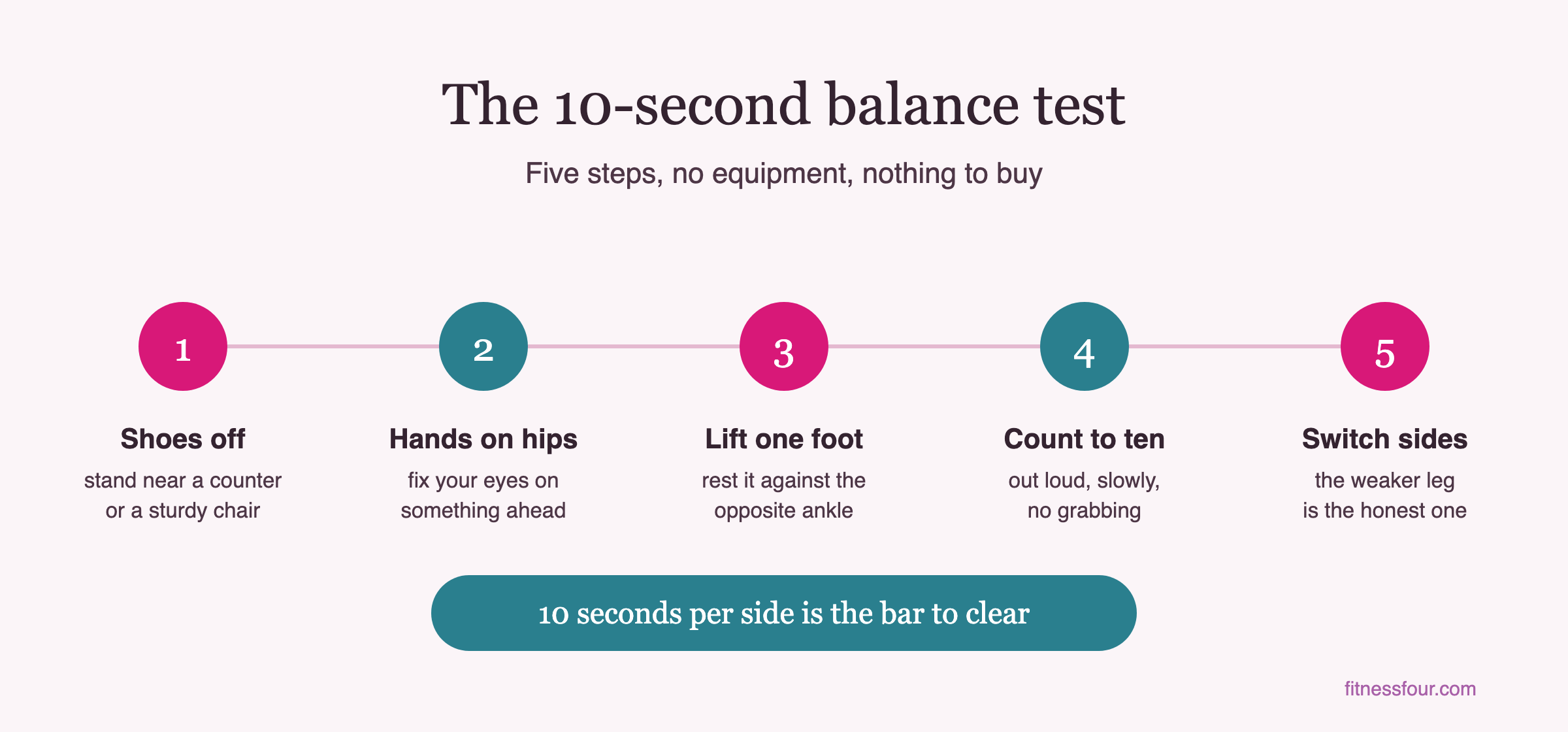
Find a place where there’s something stable nearby, like a counter or chair, and remove your shoes. Place your hands on your hips, look forward at something (TV? Wall?) and raise one foot off the ground so that it either touches your other ankle or floats above the ground. Then simply count aloud slowly to ten.
You cannot jump up, reach for anything or flail your arms wildly. Once you’ve counted to ten switch sides, because most people have one side noticeably weaker than their other side. Your weaker side is always going to be honest about how badly off you are.
If you’re able to perform this test on both sides without issue, that’s quite an achievement. But if you didn’t succeed, don’t worry, this is definitely one area of getting older where you can make corrections.
Why does ten seconds matter?
Balance may appear like something ridiculously easy until you understand what constitutes stability and why the loss of it happens before losing any other function of our bodies. It takes hip and leg muscles, vision, your sense of spatial awareness, input from your inner ear balance organs as well as pressure sensors within each foot, and finally input received from all sources simultaneously by your brain, which rapidly puts all the pieces together into the tiny adjustments needed in order to remain balanced.
When any portion of this process slows down we start wobbling before anything else shows signs of decline, and that’s why researchers continually discover that balance ability is consistently correlated with what comes later. Standing on one leg doesn’t keep you alive, it indicates whether many processes beneath are functioning properly.
And practically speaking, the stakes here are falls. Among adults 65 and up, approximately 1 in 4 fall per year, and falls lead to broken hips, long hospital stays and the long slide of being afraid to move. Once seniors have experienced falls they begin fearing movement as well, which causes them to move less, which makes their balance even worse, and around we go.
How does balance fail first?
This is something I didn’t know before reading about all this: balance begins declining at age fifty, not eighty, due primarily to lack of use. Children spend their days climbing stairs, hopping curbs, standing on one foot while pulling pants up, dancing.
Adults however spend nearly all their daily activities sitting, car, office, couch, walking from flat surface to flat surface, each foot planted, with the systems responsible for keeping you steady being use-it-or-lose-it, and modern adult routines quietly removed every rep, muscles get a little weak, reaction time gets a little slow, and none of these things announce themselves until the day the curb is icy.
What am I doing now
I won’t add an extra formal workout routine into my schedule; therefore, I have combined a daily exercise to the existing activities I perform, and this is the only way it has worked. Each morning while brushing my teeth I stand on one leg, left foot for the top teeth and right foot for the bottom teeth.
This gives me about two minutes of practice each morning. I now put socks on standing up as well (this may seem trivial), but it was embarrassingly difficult for the first two weeks. There are times when walking from the bedroom to the laundry room, where I will randomly place one foot directly in front of the other, and attempt to place heel to toe, almost like a low-stakes sobriety test.
Those are all the exercises that make up my entire program. After thirty days I can hold ten seconds on my good leg without any problem or drama; and my bad leg stopped acting silly within a month too.
If you’d rather go structured, tai chi keeps showing up in research about falls as the best thing older adults can do, and senior centers everywhere teach it cheap, YMCAs too.
If you wobbled
Start again immediately adjacent to a counter, place two fingers on the edge of the counter, then one finger, then hover your hand, and you’ll be surprised how fast the progression moves, because your brain relearns this stuff fast when you give it reps. Barefoot helps, since your sensors read the floor better without cushioning getting in the way.
Do the bad side twice as often as the good side. If you’re dizzy rather than just wobbly, or you’ve had previous falls, talk to your doctor before starting here, dizziness is a different problem than weak balance and deserves its own attention.
- Rest two fingers on the counter edge while you balance.
- Drop to one finger once that feels steady.
- Hover your hand just above the counter, no contact.
- Free-standing, no hands, both sides. Most people climb this ladder faster than they expect.
The ten seconds isn’t really the point. The point is that there are few aging measurements where you can actually make changes in a month, at home, free, in your bathroom, while doing something you were doing anyway. I’d rather work on the thing that keeps me off the bathroom floor at 80 than most of what the wellness world is selling me, and it costs nothing but those two minutes spent with a toothbrush in hand.