
What Time Should You Stop Eating Before Bed? Here’s What Science Says

I came across this information while trying to understand my own problem; it happened while I was going through a series of nights of very poor quality sleep, around the time I was consistently having my dinner at 9 pm and I’d rationalize the later dinner saying “I deserve it.”
You may already know from reading my post on how I create an evening routine down to the light bulbs to protect my sleep that if I suspect dinner as being part of my sleep problems, then I’ll look for the actual research instead of Wellness Blogs that have much (if not all) of the wrong ideas in relation to this issue.
There isn’t some magic number or hour for your fork before bed but there’s real scientific backing behind that two to three-hour rule you’ve probably heard many times before, just not based on the assumptions everyone else thinks exists. The true target is closing off your kitchen about three hours before lying down and what were interesting reasons ended up being a lot different than “You’ll Get Fat”, which is the version we all received and one of the weaker claims on this list.

The strongest reason is also the least glamorous
You may be familiar with this area of your body if you have eaten a large amount of food at dinner and then woke up with that “burn” feeling going all the way to the top of your chest shortly after falling asleep. The biggest number from reflux studies was in a 2005 study published in the American Journal of Gastroenterology, which measured time between dinner and bedtime as a variable for acid reflux.
Researchers looked at how much time passed between when participants ate their last meal and when they went to bed, and found that those who waited less than three hours (7 times) were more likely to experience acid reflux than those who waited four or more hours, regardless of whether the participant smoked, drank alcohol, or was overweight.
Gravity explains why we feel better when we stand up versus lie down after a meal, gravity works on our stomachs just like it does everywhere else; when we’re standing up, gravity helps keep stomach acids in place but once we lie down after eating, gravity has no effect on stomach acids and instead pushes them out through an unnatural path.
Also, stomach acid production increases later in the day making the timing worse. This study is the basis behind gastroenterologists telling their patients to avoid eating for two to three hours before sleeping; this information is where many of us got our rule about stopping food intake by two to three hours before sleeping.
The blood sugar part is real, and the villain is melatonin
I hadn’t known this, and I think that’s what gave me pause with my fork mid-air. Melatonin isn’t a sleepy hormone; it’s also a signal to the pancreas telling it to stop spitting out so much insulin. Insulin is the hormone responsible for clearing sugar from your bloodstream after you’ve eaten. So, eating late sends excess food into an insulin-starved system as its “clocking” out for the night.
A meal consumed at 10pm will spike your blood sugar levels to a greater extent than consuming the same meal at 6pm (without changing anything else). Researchers were able to quantify how eating later can cause issues by conducting a 2022 crossover study published in Diabetes Care, they had participants consume an identical meal about 4 hours before bedtime versus about 1 hour before bedtime.
When eating closer to bed time, their melatonin spiked about 3.5 times higher while their insulin production decreased, leading to increased blood glucose levels. In people who have the most common variant of the T2D risk gene (which many of us do), these effects are amplified and unfortunately there’s no easy way to determine whether you have this gene without undergoing genetic testing, although no one seems interested in doing such testing to determine this information; also, women post age-50 tend to experience fluctuations in blood glucose that are generally less optimal than those experienced during earlier years of life, so I’d be very cautious based on this evidence alone regardless of whether you experience acid reflux symptoms or not.
The weight claim is the one to hold loosely
I’m going to be the annoying friend who read the papers everybody keeps repeating, and then I’ll be able to tell you what was wrong about them, especially since they’re all pretty weak claims. So there’s a nice Harvard study in Cell Metabolism from 2022 that’s always being thrown around.
It found out some true stuff: When people ate the same meal again four hours after they first ate it (and that was their last meal), those people got hungry faster, used slightly fewer calories for energy, and stored fat instead of burning it (all signs point towards “Late meals make it harder to lose/keep weight”).
The study only looked at sixteen subjects; thirteen of whom were men; the average age of participants was thirty-seven, so while it showed us something we can use as an engine to potentially lead to weight gain…it didn’t show us anything that would represent actual pounds lost/gained. And more importantly, none of these studies are looking at any one older than twenty years old.
That doesn’t mean I wouldn’t say its worth reading though…since it seems to go in the direction of every other piece of evidence. Anybody telling you Science has proven that late dinners add weight onto a fifty-eight year old woman is essentially giving someone money for a service they can’t deliver either. Same goes for the sleep claim – which is kind of humiliating considering this whole thing started for me because I woke up late and couldn’t fall back asleep until morning.
There does appear to be some correlation between eating late and waking up during the night more often…but mostly this is based on survey data and many of the better studies contradict each other. – I do believe my large late dinner completely ruined my ability to sleep through the entire night…but if anybody tries to prove how much it messed with me (i.e. How many hours less I slept per night)…I don’t know if anybody has done that yet…no matter how confident the headline sounds like it’s trying to convince you otherwise.
The exception nobody mentions: a little protein is fine
I know some of this sounds like my personal crusade to be the most judgmental person alive, and there are certainly things people eat before bed for which I do have zero tolerance (see: pasta with red sauce). But there’s actual science supporting one thing that may help with sleep and eating: consuming a very small portion of slow-digesting protein about an hour before bedtime.
Casein is a good example of this type of protein; it’s found in milk, and it provides your muscles with nutrients throughout the night when you’re asleep. Researchers have demonstrated that casein enhances recovery processes during nighttime hours, regardless of age, including older adults. And as far as I’m concerned, maintaining muscle mass past 50 years old will win half the battle.
So, adding two or three spoons full of cottage cheese or one small bowl of Greek yogurt about an hour before bedtime is clearly not the same as having a large plate of pasta accompanied by a glass of wine. A couple of scoops are providing your body with additional protein, they aren’t creating another “meal” or causing your blood sugar levels to rise like would happen if you had dinner.
The only limitation, explained through researcher language: these studies were primarily conducted using male subjects, so while a general muscle-enhancing effect was established, there has been virtually no testing about its effectiveness in females specifically. For now I’ll continue to store the yogurt in my refrigerator anyway.
So what do I do
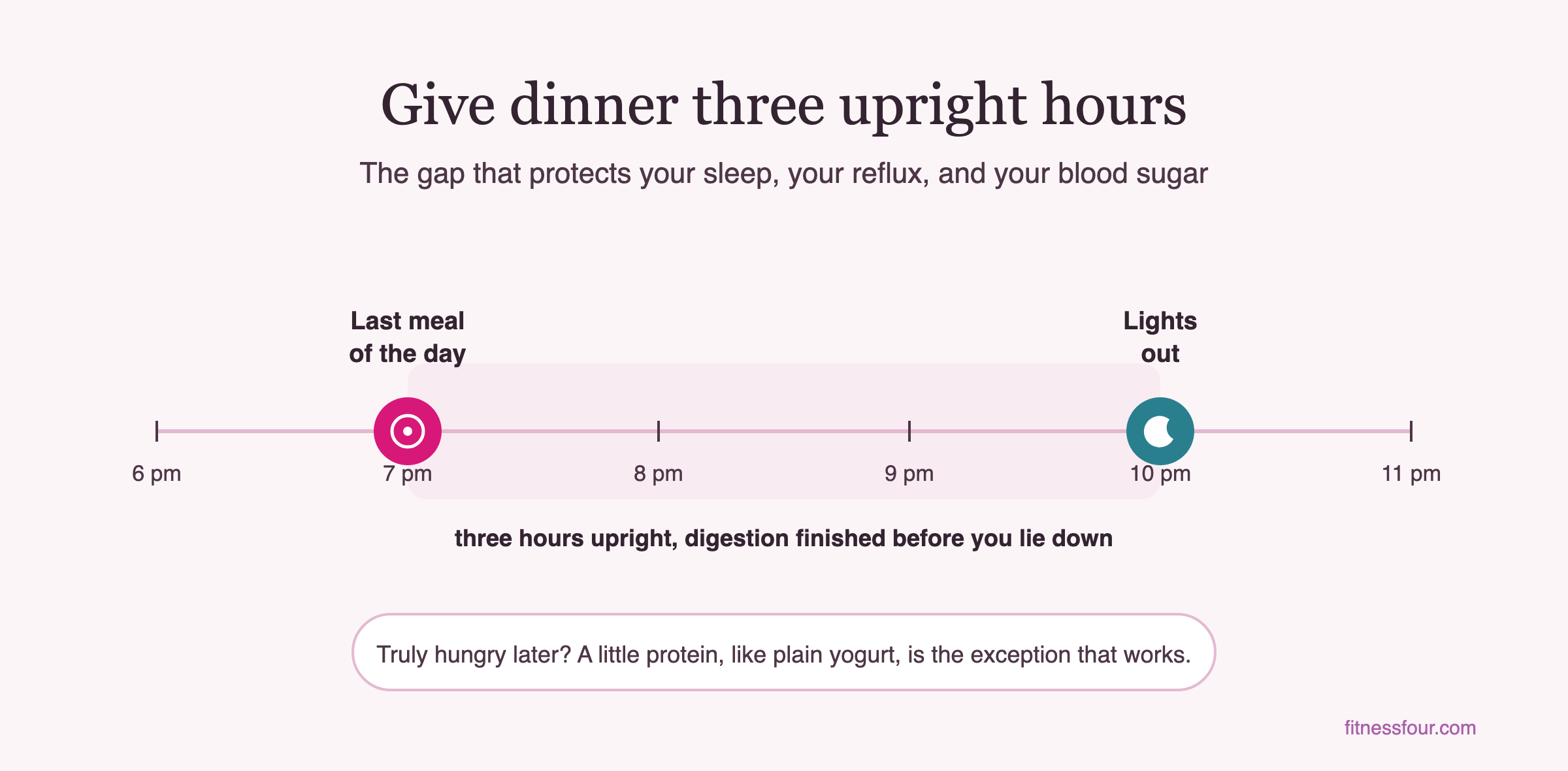
I try to eat my last meal of the day around 7 p.m. And go to bed at 10 p.m. So, I try to get ready for bed and be asleep by 10, with dinner finished three hours prior (around 7). For me, this has become a goal that I hit most nights instead of an “everynight” rule, because breaking a plan twice and giving up is far worse than keeping a habit loosely.
If dinner does run late or longer than usual, I make sure to have something very light for myself, as well as skip the wine when I’m going to go straight to sleep; alcohol close to bedtime plays tricks on how much sleep we can get. If I do find myself still hungry, there will always be yogurt available and losing even one minute of sleep over it doesn’t seem like too big of an issue.
This is essentially why I picked the three-hour mark in particular. The reason the three-hour time frame isn’t some kind of law of physics is because it’s where the reflux studies meet with the blood sugar studies AND plain common sense come together. After the first month during which everything began, it’s been the only habit from my entire renovation process that made any real headway into being regular.