If You Can Master These 5 Standing Exercises at 65, You’re Fitter Than Most 50-Year-Olds

Medically reviewed by Stephanie Wright, RN, BSN
Fitness after 50 doesn’t have to look like fitness at 30, but age alone doesn’t tell you much about what your body can do. Your ability to perform simple, common, everyday movements tells you something useful about your functional fitness — how well your strength, balance and mobility are holding up. It is not a picture of your overall health, which turns on plenty these movements cannot see. Researchers and clinicians know this. That’s why they use common-sense tests like the following to assess strength, balance, and functional fitness.
All of us have varying degrees of balance, flexibility, agility, coordination, mobility, and stability. These abilities can be gauged in part by everyday movements, getting up out of a chair, picking up a bag of groceries, stepping over the rug in the hallway. They’re skills we take for granted until they’re challenged. And then they’re not so easy anymore.
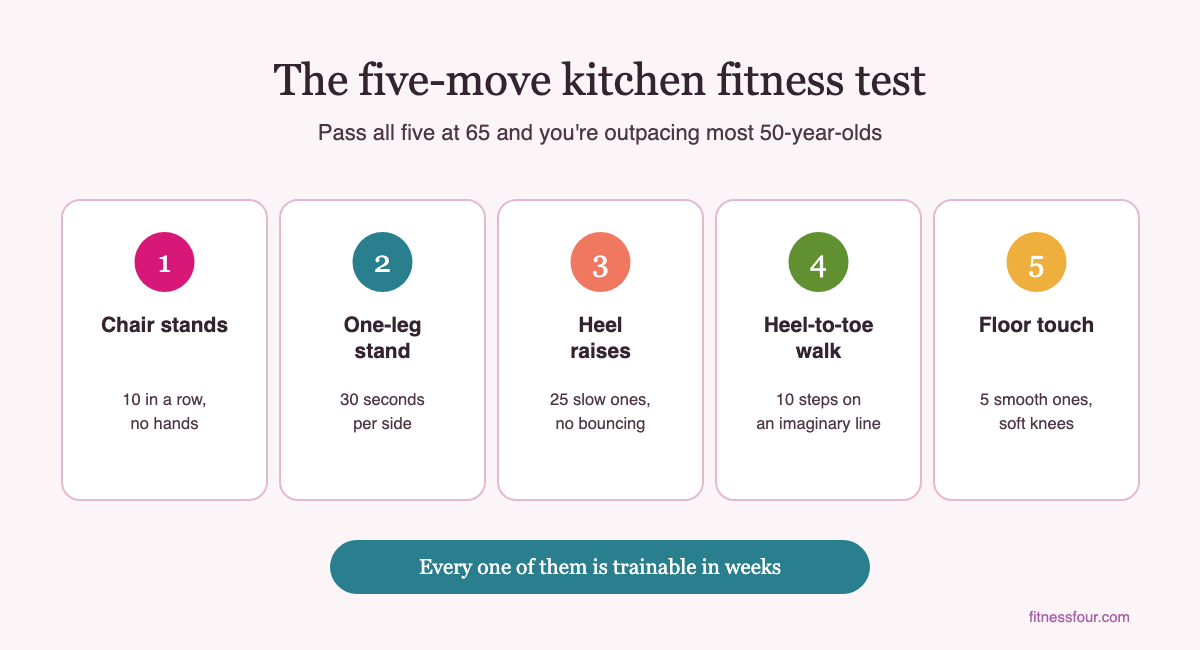
Here are five movements that will test your functional strength, balance, and flexibility. Try them all and count how many of them you can do. At the end you’ll find out what that means.
If you can do all of these with confidence at 65, that is a genuinely good sign about your strength, balance and mobility.
Find a counter or chair within reach to stabilize yourself if necessary.
1. Stand up from a chair 10 times without using your hands
With arms folded across the chest, stand up out of a chair and sit back down as fast as you can. Score yourself on the number of repetitions completed within 30 seconds. Researchers compare that count against age-banded norms rather than one universal number — what is typical at 60 is not what is typical at 75 — so the most useful thing you can do with your score is treat it as your own baseline to beat.
Stand up off of a standard-height chair without using your hands, 10 times in a row. If you’re sinking into the couch at night and having trouble getting up, this is a must-do. It will help with getting out of cars, toilets, chairs, and off of the floor if necessary.
Your thighs and bottom are major players here. We don’t often notice gradual decreases in strength until one day we can’t get up out of that cushy, low sofa, or a car or toilet, as easily as we used to. If you’re challenged by this test/exercise, stand up out of a higher chair; allow yourself to stand with fingertips on your knees; or start with five chair stands and add another one each week.
2. Balance on one leg for 30 seconds
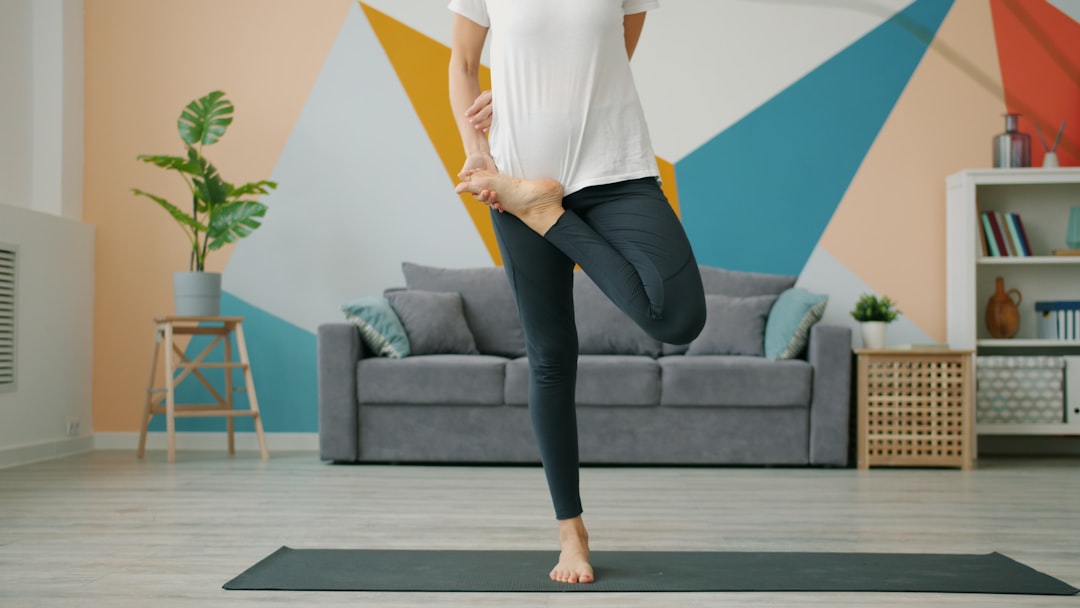
Stand with feet together and lift one foot. Hold that position for 30 seconds. Score yourself on how long you lasted with good balance. Repeat with the other foot.
A study of adults between the ages of 51 and 75 found that those who couldn’t pass the single-leg balance test, holding one foot up with your eyes open for 10 seconds, were about 84 percent more likely to die in the years that followed. Only about 20 percent couldn’t pass it. Read that finding carefully, though: failing the test does not cause the risk. People who cannot hold a single-leg stand tend to have other things going on, and the test is picking up on those.
Balance requires coordination among the nervous system, the vestibular system in the inner ear, the musculoskeletal system including the strength and health of joints, and more. It’s no joke.
Do this exercise while brushing your teeth or making your morning cup of coffee. Balance tends to respond well to regular practice, though how quickly and how much it improves varies from person to person.
3. Do 25 slow heel raises
Stand tall with your feet about a hip-width apart. With fingertips lightly touching a counter, raise yourself up on your toes, pausing at the top. Come back down slowly. That’s one repetition. Do 25 with a rhythm of 2-counts up and 2-counts down. Score yourself on how many you could perform with good form.
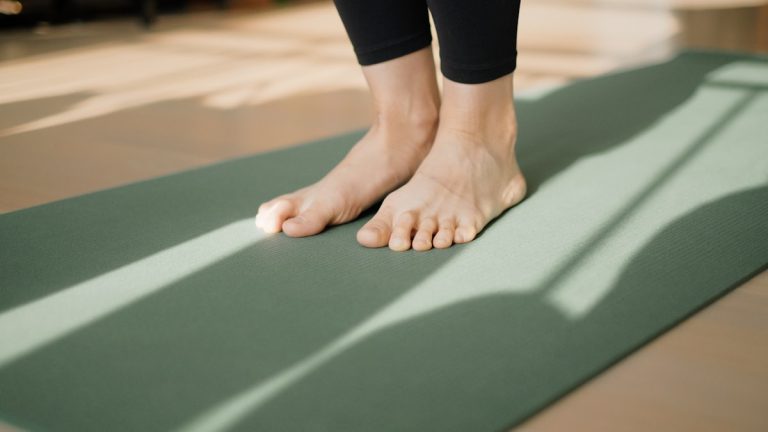
Stand with your hands lightly touching a counter and raise up on your toes and lower. Do this while you’re waiting for your coffee to brew. If you’re having trouble getting to 25 calf raises, start with what you can manage and build up. Calf raises will help your circulation. Your calves are known as your second heart because the muscular contraction helps pump blood back up your legs. Strong calves also do much of the work in a crisp, confident stride. What they are not is the explanation for every tired leg: swollen ankles in particular can come from vein, heart, kidney or thyroid problems or from a medication, and that deserves a doctor’s look rather than more calf raises.
Once you’re getting 25 calf raises, try them on one leg. That will make them twice as hard without buying a single piece of new equipment.
4. Walk heel-to-toe for 10 steps
Also known as tandem walking, heel-toe walking is 10 steps taken placing the heel of one foot to the toe of the other without losing balance. Take those 10 steps down the hallway holding onto the wall. Then take them without the wall. Then take them with a glass of water in one hand. Why? Researchers use tandem walking as a test of balance because it’s a test of balance in motion (dynamic balance) as opposed to standing on one foot which tests balance at rest (static balance). It takes coordination and focus to walk in this way. Your hips and ankles will make lots of micro-adjustments to keep you balanced. Those are the same adjustments that will help you from falling when you trip over an obstacle. Holding the cup adds another element that emulates everyday life: divided attention. We’re almost never just doing one thing at a time, are we?
5. Touch the floor with soft knees, then stand back up
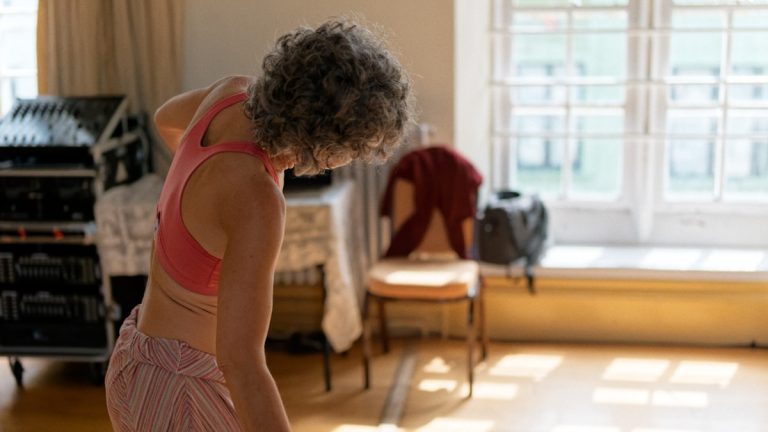
Stand with your feet about a hip-width apart. Bend your knees just a tad and push your bottom backwards while reaching down as far as you can towards the floor. Come back up without bending forward or grasping onto something for balance. If you can do this without grabbing something or bending forward for 5 reps, you’ve passed. This test is important because it requires flexibility in the hamstrings and strength in the hips. It tests balance in another plane of motion: bringing your head closer to the ground and then back up. Some women get dizzy bending over or standing back up. That is not something to practice your way through — it can come from a drop in blood pressure, an inner-ear problem, or a medication you take, so raise it with your doctor before you keep at it. You might only be able to reach your knees or shins at first. That’s okay. Work on it while brushing your teeth.
This requires a fair amount of hamstring, lower back, and overall body flexibility. Work on it and you’ll be rewarded by increased ease of movement, decreased aches and pains, and an overall feeling of ease and wellbeing.
What your results tell you
If you can do all five, your balance, flexibility and lower-body strength are in good working order. There is no scoring table behind that — five out of five is not a validated benchmark, it simply means none of these everyday movements is giving you trouble. If you can do 3-4, focus on the movements that are harder for you. If you’re having trouble with most of the movements, I’m glad you know. Now you have a plan of action. Practice the movements that gave you trouble and most people see some improvement, though the pace of it varies. This is true even if you’re in your 70s and 80s. Then try the tests again in a month.
The best part about these movements is that they can be worked into your day, don’t require special equipment, a gym, or a fitness membership. Practice calf raises while standing in line to use the restroom. Practice tandem walking down the length of a rug. Practice getting up and squatting down when picking up laundry or groceries or kids.