What Time Should You Stop Eating Before Bed? Here’s What Science Says

“I deserve it.” That was the argument I’d been using to defend those late meals.
I’d been having issues with poor-quality sleep for a while. Since I realized that one culprit was likely that I was eating dinner way too late, usually around 9 p.m., I’ve been working on changing that habit.
I’m changing my evening habits, including my light-bulb habits. And, of course, I researched it, wondering if it’s important to time dinner wisely.
While this is just anecdotal evidence based on my own experience, it seems to make sense. Here are some of the studies that support changing up your dinner time.
The clearest reason is reflux
A 2005 study published in the American Journal of Gastroenterology found a strong association between reflux disease and eating less than three hours before going to bed compared with at least four hours before bed.
Specifically, people who ate less than three hours before bedtime had more than seven times the odds of reflux compared with people who waited four or more hours before bed. This held true even after controlling for other factors that raise the risk of reflux, including smoking, drinking, and body-mass index (BMI).
It’s a correlation, not causation, so it’s not necessarily due to meal timing alone.
When you eat and lie down immediately afterward, your body is horizontal. But when you’re standing or sitting upright, gravity is keeping food in the stomach where it belongs. When you’re on your back, it’s easy for whatever is in the stomach to seep back up the esophagus.
Your body handles sugar differently late at night
A 2022 study of 845 adults published in Diabetes Care looked at how the timing of eating affects the body’s ability to manage glucose. Participants were asked to consume a glucose-containing beverage four hours before bed during one part of the study and again just one hour before bedtime during another part of the study. It’s what’s called a crossover study, meaning that everyone is their own control.
The researchers found that the hormone melatonin, which increases at night, affects the body’s ability to manage glucose. When participants had the drink just one hour before bed, their melatonin levels were about 3.5 times higher than when they had it four hours before bed. Insulin levels were lower when participants had the drink closer to bedtime.
This is important because insulin helps clear glucose from the bloodstream and move it into cells to be stored. When insulin levels are lower, glucose levels are higher. So, all in all, participants had higher glucose levels when they consumed the drink just one hour before bed compared with four hours before bed.
These effects were stronger among study participants with a variant of a gene for a melatonin receptor, which happens to be a gene that is associated with a higher risk of type 2 diabetes.
The weight claim needs more context
A small, tightly controlled study published in 2022 in Cell Metabolism, which was led by Harvard researchers, looked at how meal timing might impact metabolism.
Sixteen participants who were overweight or obese but otherwise healthy, 11 of them men, with an average age of about 37 participated. Over the course of the study, the timing of meals was manipulated to be four hours later compared with baseline.
The results suggest that eating later in the evening may be a signal to the body to conserve energy by storing fat, increasing feelings of hunger, and lowering energy expenditure.
They’re looking at physiological response, not actual weight loss or gain, so we cannot extrapolate that eating dinner too late causes women over 50 to gain weight.
More research is needed to determine if meal timing actually influences weight gain.
What about sleep itself?
There have been a number of studies showing associations between eating and sleep quality. However, the results from tightly controlled studies looking at meal timing and the architecture of sleep have been mixed. And, in general, participants were asked to rate the quality of their own sleep, which is subjectively determined.
A small protein snack is a different question
A number of studies have shown that consuming a protein-rich snack before bed could support muscle protein synthesis, especially in older adults.
The idea is that casein, a type of protein that’s found in milk, digests more slowly. As such, amino acids from casein are trickling into the body throughout the night to promote muscle-protein synthesis.
However, many of these studies have been conducted in men using high doses of protein, so it’s unclear if consuming a small amount before bed would provide any benefit for women.
There’s nothing magical or medically proven about my go-to snacks, small servings of Greek yogurt or cottage cheese, but it’s nice to have something in case I’m hungry. A small snack is nothing like a second dinner.
What I do now
The main goal for me was to eat at least three hours before I went to bed. For someone who goes to sleep at 10 p.m. or so, that means finishing dinner by 7.
It’s been going OK, it’s certainly a work in progress, but there have been improvements. When I do end up eating later, I try to make sure whatever it is I’m eating isn’t as hearty. And it’s OK to have a glass of wine with dinner, just not late at night.
- Finish a substantial dinner about three hours before lying down.
- Keep a late meal smaller when an earlier dinner isn’t possible.
- Pay attention to whether late food or alcohol worsens your symptoms.
- Distinguish a small snack from eating another dinner.
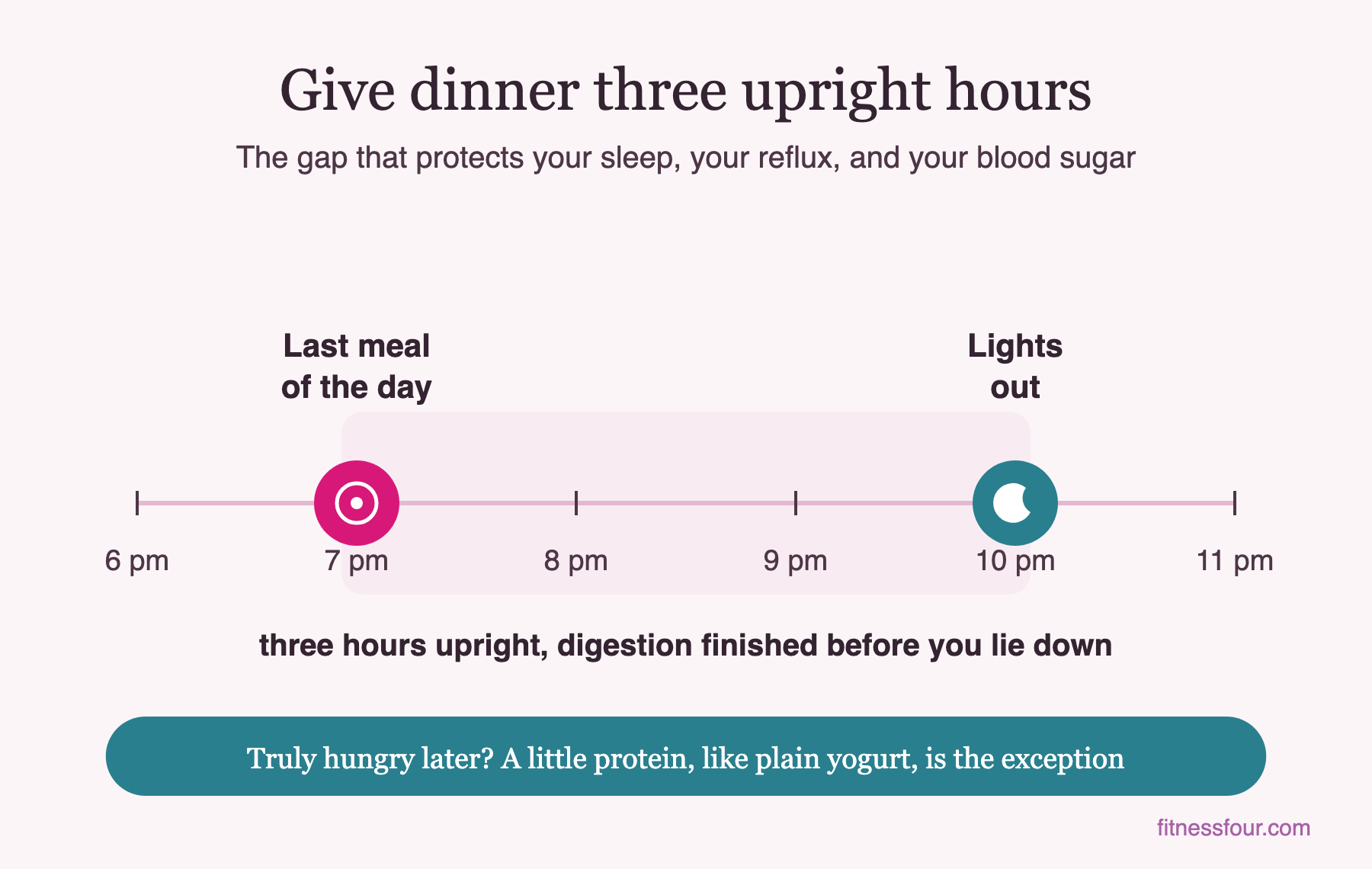
Use your bedtime as the reference point
For me, what matters most is how long between eating and getting into bed I allow, and what’s going on in my body: how often I’m getting heartburn, waking up during the night, and how easily I’m falling asleep.
Should you completely overhaul your nighttime-eating habits if you’re guilty of munching right before bed? Not necessarily. However, eating three hours before bed could be a goal, although I would frame it as something to aspire to and not necessarily something you’re failing at if you don’t always hit the mark.
If you are going to eat within three hours of bedtime, try to eat something smaller and skip the wine. If you’re hungry before bed, grab a few bites of yogurt.
When an early dinner isn’t possible
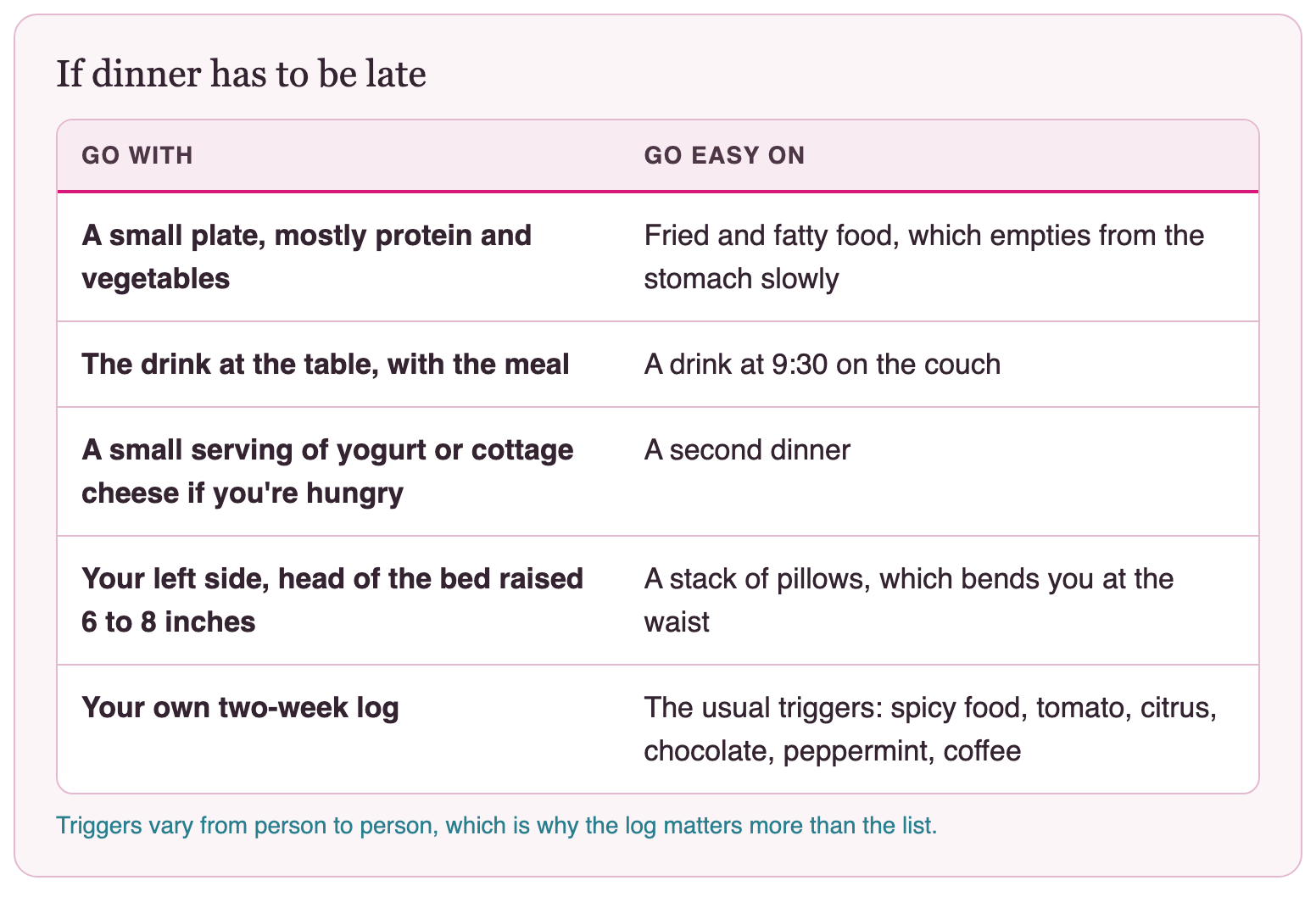
And of course, it’s not always possible to have your last meal at least three hours before bedtime. Some people have to work late, have a reservation or a late flight. Others have a family that can’t sit down until 8:30. In those instances, I find it best to make dinner smaller, meaning some protein and vegetables. Eat a larger lunch so you’re consuming the same amount of food.
It’s just switched around. If you know you’re going to be eating later than usual, have a big lunch that day and a lighter dinner. Trust me, skipping dinner only to wake up ravenous at 3 a.m. isn’t worth it. And if you’re on nights, apply the same rules to your schedule.
Eat dinner three hours before you have to go to sleep, perhaps that’s at 8 a.m. or 3 p.m., but give yourself that window to digest. That’s why greasy, high fat foods are not good if you’re eating close to bedtime.
Fat slows emptying of the stomach so if you have a super rich, fried meal and lie down an hour later, then food is still sloshing around in your tummy. And, of course, avoid the classic heartburn foods, although every body reacts differently. Gastroenterologists always rattle off a list of foods to avoid, like tomato sauce, spicy foods, citrus, chocolate, peppermint, coffee.
Pay attention to what works for you and what sets off symptoms.
Sleep on your left side and raise the head of the bed
Two other suggestions: Elevating your head while sleeping can help you manage acid reflux symptoms without changing your diet. By raising the head of your bed by about six to eight inches, you’ll be able to sleep more comfortably. To do this, either place some blocks under the legs of the bed, the two on the headboard end, or invest in a wedge to place under your mattress.
Do not just pile up your pillows, because your body will be bent at the waist, not elevated, and may actually promote your stomach contents to work its way up the esophagus. Sleep on your left side. The position of the organs within our bodies makes it so that our stomachs are positioned lower than our junction with our esophagus when we lie on our left sides.
Studies looking at nighttime acid reflux found that reflux occurred less often, and acid exposure was lower when they slept on their left side as opposed to their right or on their backs. I find that where I wake up varies so I don’t worry about it, but the first couple of hours of sleep are the most important because you’ve recently eaten, and that’s when I begin on my left side.
Alcohol is its own lever
I said above that a glass of wine with dinner is fine, and I stand by it, but the timing of that glass matters more than the glass. Alcohol relaxes a muscle at the bottom of the esophagus which helps to keep your stomach contents in your stomach, so it contributes to nighttime reflux.
Drinking an alcoholic beverage at 9:30 while relaxing on the couch will do your body more harm than drinking that same alcoholic beverage at 6:30 while having dinner. Alcohol has an outsized impact on sleep as well. While it can help you fall asleep faster, it also leads to less dream sleep and more awakenings, particularly during the second half of the night, and it makes your snoring worse.
So, my request: finish the drink with dinner, and don’t pour another one later.
The early-window studies point the same way
Whereas the Diabetes Care study focused on one glucose drink taken 1 hour before bedtime, another study done by researchers at the Pennington Biomedical Research Center focused on all food consumption. Published in 2018 in Cell Metabolism, the study gave eight men with prediabetes diets that would keep their body weights stable.
For five weeks they ate everything within a 6 hour period that ended by 3 pm; for five weeks they ate the exact same meals within a 12 hour period. The early window made them more sensitive to insulin and lowered their blood pressure. The men also reported being less hungry in the evening. None of this had to do with weight loss.
This is an important point to keep in mind, especially when the sample was limited to eight men with prediabetes, which is a long way from the women over 50 who read this site. Nonetheless, like many of these studies, it backs up the idea that refraining from late-night food seems to have beneficial effects.
Two weeks of notes beats any of these studies, for you
So what’s in the log? Well, I’m a numbers person, so this is what I recommend logging for two weeks before changing anything. Time you’re done eating, how large a meal it was (big, medium, small), if/when you had a drink, what time you went to bed, if you had heartburn as a simple yes or no, how many times you woke up that night, and, when you get up in the morning, say 7 am, rate your overall feeling from 1-5.
After two weeks, look at your three worst nights and your three best nights, and see if anything jumps out at you. Chances are, something will. Most people find that there’s one thing that stands out, and it’s often not what they think it’ll be. For some people it’s fine to have a late dinner so long as it’s smaller, but a late drink keeps them up, or vice versa.
Your mileage may vary. This is why I suggest logging because there’s plenty of studies out there about what’s best, but logging your own information gives you the best info on your body and sleep schedule and digestive system. Log on a spreadsheet, log on your phone in a notes app, or log on the back of an envelope, whatever is easiest.
Late-night hunger usually starts at lunch
One other point I want to mention that I’ve recently realized is how important it is to get 25 to 30 grams of protein in with lunch, a number we preach about on this site for breakfast. Some days I’ve been getting off work and feeling really hungry and raiding the pantry. But then I realized that most of those days, my lunch had been underwhelming.
Maybe just a granola bar at my desk or a sad little salad consisting solely of leaves. Those are not going to cut it. Those are the days where dinner becomes a rescue mission to make up for all of the food I did not eat earlier that day.
But when I eat a really well-rounded lunch with tons of solid food and enough protein, I’m rarely hankering for a second dinner around 9. So, eat well at noon. And, on those rare occasions you DO crave something at 9, try to limit it to just some yogurt or cottage cheese. That should do the trick.
When heartburn needs a doctor
Finally, if you’re having any of the following, then it’s time to get checked by a doctor: difficulty or a sensation of food getting stuck when swallowing, unexplained weight loss, vomiting, black stools, bloody stools, persistent cough, persistent hoarse voice, and of course, if you’re having chest pain, as this is the only way to rule out a cardiac cause.
I’m not a doctor, but certain symptoms do need to be evaluated by one, in an exam room. Heartburn two or more times a week for a number of weeks warrants an appointment, especially if you’ve already implemented certain lifestyle changes, like adjusting your dinnertime or cutting back on late-evening drinking, etc. Taking antacids for months on end might mask the problem, but you’ve still put off seeing a doctor and finding out what’s going on.
Count back three hours from your bedtime
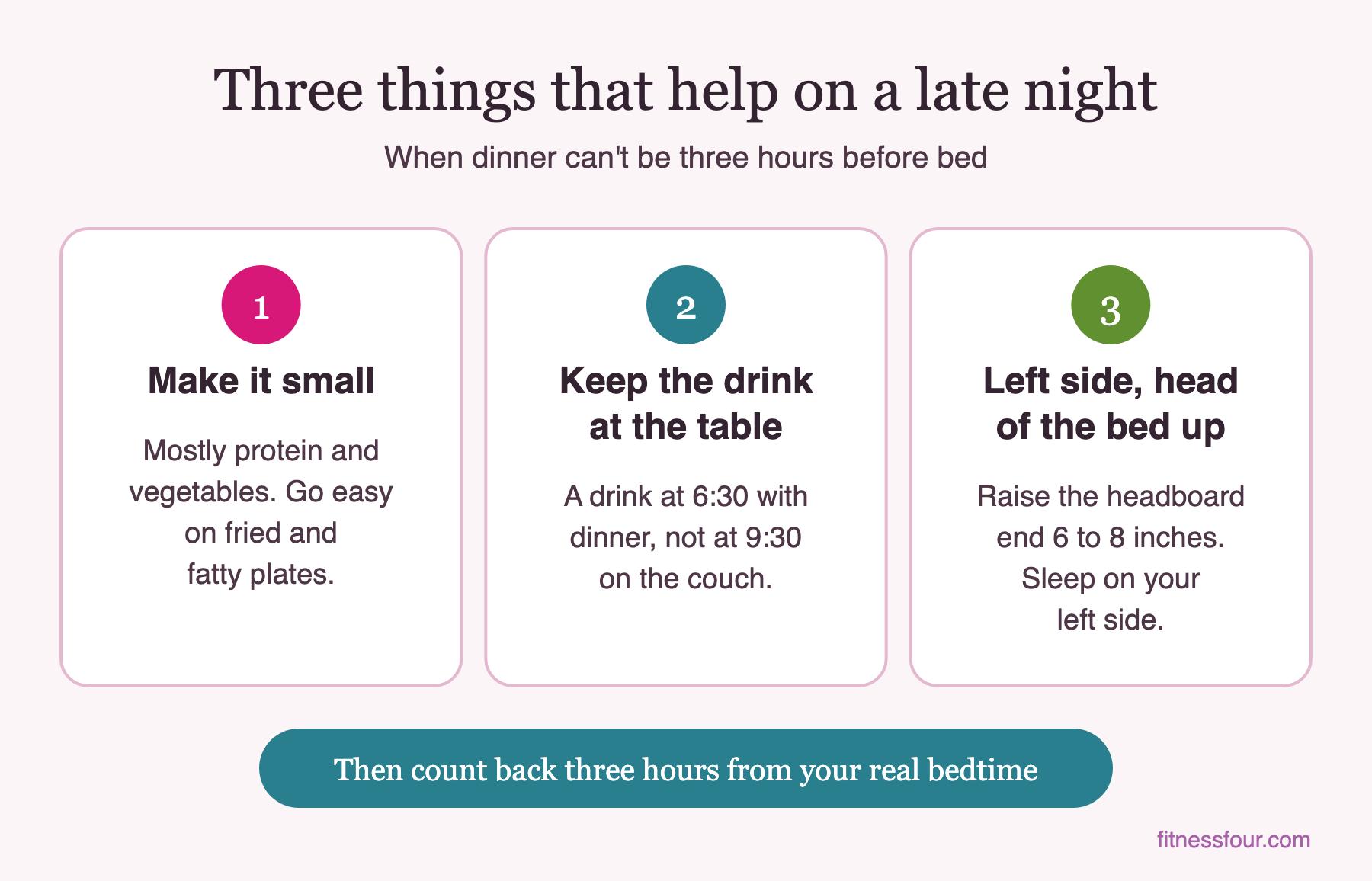
Subtract three hours from your actual bedtime, not the bedtime you wish you had, but your realistic, honest, true-to-life bedtime, to determine when you should stop eating dinner. That’s pretty much what this article is about. Or pick your bedtime below and the tool does it for you. As for me, I’m a 10 p.m. sleeper, which means dinner is at seven. When dinner is later than that, I’ll eat a smaller amount, leave the drink at the table, and sleep on my left side.