Bed Exercises for Seniors: Better Sleep and Easier Mornings


I have multiple older clients who tell me stories about what it is like every morning—particularly how they feel. The first minute of waking up in the morning can really tell a lot about the day ahead—and it is often the time when my clients feel pain. Why they feel this before even taking a step often is baffling, but night time can have similar effects.
Bed exercises help to establish the day ahead and even just a little movement when lying on your back can be enough to get the blood flowing and happy compounds rushing throughout your body. While the first thing you do in the morning doesn’t have to be jumping out of bed and immediately exercising, there are reasonable options to get your joints warmed up before you get up for the day. Then when bedtime nears, the thought of working out does not always work in favor of a good night of sleep—but slow and controlled movements may help the unwind process.
Why Mornings Are Stiff
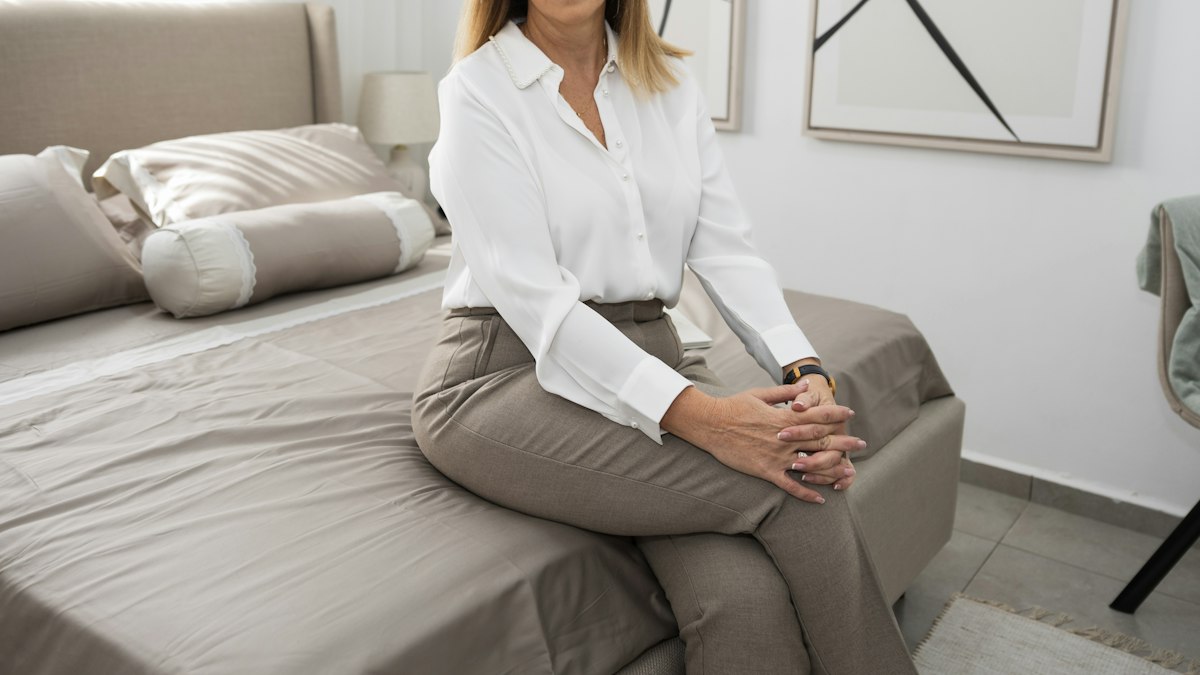
When my clients tell me about their mornings, they often tell me how their joints ache—particularly in their hands, knees, and ankles. Pain is caused from a number of reasons and seniors can definitely attest to theirs. Whether it is climate, disease-related, or injury, the joints are usually the first culprits of pain and stiffness.
The evidence of morning stiffness and pain tells the strong story. A 2024 study performed in the Turkish Journal of Physical Medicine and Rehabilitation collected data from 26 adults with rheumatoid arthritis, 23 of which were female, alongside 26 healthy adults as a comparison group. This study aimed to objectively exhibit morning stiffness, and it measured everyone twice in the same day—once between 8 and 9 in the morning, and again between 3 and 5 in the afternoon. The adults with rheumatoid arthritis reacted more slowly, reported more pain, and had weaker grip strength in the morning than they did that same afternoon. The healthy group showed no difference between the two times of day, which is what makes the finding worth paying attention to.
Then a 2020 study published in Arthritis & Rheumatology examined synovial tissue from 176 adults with rheumatoid arthritis who had hip or knee replacement surgery. The presence of immune cells called neutrophils, along with fibrin, in that tissue was associated with morning stiffness lasting longer than an hour. Neutrophils are immune cells that help us to fight infection when the body is exposed, which contributes to inflammation. In return, this inflammation could be responsible for the pain that older adults experience. A commentary on that study in the same journal raised the body clock as a possible explanation—that the timing of when those cells show up may be part of why stiffness lands hardest in the morning.
Sometimes waking with pain is due to your hormones. A study from 2025 highlighted in the Journal of Pain followed 1,246 adults for seven years to look at why hormones can affect morning pain. It was found that people whose cortisol declined more slowly through the hours after waking had increased odds of developing chronic pain in many areas of the body. This is a big deal because cortisol is one of the body’s own brakes on inflammation, and a decline that flattens out instead of falling the way it should could explain a lot.
The Morning Set
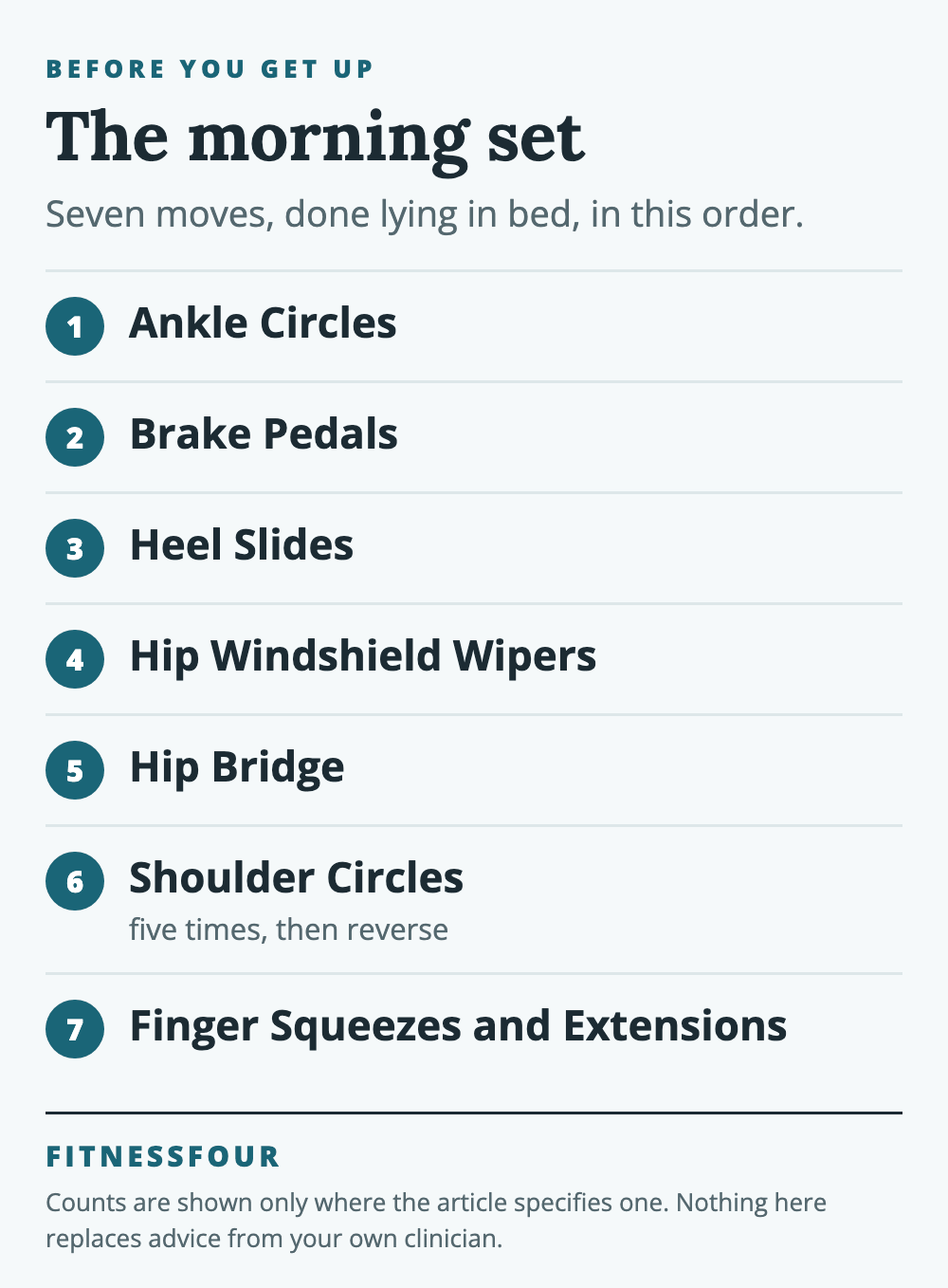
Before you get out of bed—when still lying down or at the side of your bed—you can get your joints warmed and ready for the day. The morning set should not feel strenuous and it should not feel straining by any means, but it should be light, manageable, and quick—only one set each!
Ankle Circles

Just as your eyes open when you wake up in the morning, the first exercise you should do is ankle circles. While resting in bed, flat down on your back, and your legs flat on the bed, gently rotate your ankles in a clockwise direction for about 10 rotations and then do another round of 10 in the counterclockwise direction.
Your pace is the key element here—take your time and don’t rush the movement. The goal here is to have a mobility exercise that should not add to pain or strain, but instead think of this as a way to get your synovial fluid lubricated, warmed, and primed for the day ahead!
Brake Pedals
This exercise complements the ankle joint, Achilles tendon, and calf muscles—all of which are vital for walking. Stay on your back with your legs flat on the bed, lift your tiptoes up towards your face, and press them back down—just as if you are driving and pressing the brake pedal. Do 10 cycles of these to allow blood flow to warm the lower body joints, bones, and muscles.
Brake pedals are highly effective exercises that are used to lubricate the ankle joints and warm up the calf and Achilles. You should not feel any strain while doing brake pedals, but if you notice that you are working hard, cut back and stop there. While I want your ankles and calf muscles to feel primed, I don’t want them tired before you start the day. These can be performed at the side of the bed if you want a different feel, just be mindful of your form while doing them.
Heel Slides
Next you’re going to need to lie your body flat on the bed, with your legs planted. I generally instruct my clients to keep their arms at the side for heel slides, but you can also put them behind your head or on your chest. The left leg remains down while you bring your right foot flat on the bed. Slide the heel towards your buttocks, then move them back to where you started.
The sheets are going to shift for this movement, but you should aim for 10 slides for the left and right legs. Heel slides are used for working the back of the legs—or the hamstrings—and this gentle movement helps to circulate the blood to this large muscle group. Now if you feel like this is a hamstring curl exercise, cut back your reps so it does not feel as strenuous.
Hip Windshield Wipers
The hips and glutes are two major areas that support the body and giving them a brief warmup to start your day can be effective for stiffness. With both of your feet planted in the bed and your upper body still in a lying down position, shift both hips to the right, listening to your body as you establish your range of motion. Move your legs back to the restarting spot and then to the left of the body—again while listening to your body.
This is one of my favorite range-of-motion activities to instruct—and to do myself—because it feels amazing on the hips. The aim is to do 10 full cycles every morning to try and help flush out the stubborn morning stiffness. Just keep in mind that windshield wipers can get intense—surprisingly—if you try to force the range of motion. Your main focus here should be to introduce a bit of motion that is comfortable without triggering your pain to get worse.
Hip Bridge
Take notice that this movement is the most challenging of the morning set, so be mindful of your limitations beforehand. Plant your feet back into the bed with your upper body lying down. Push your feet into the bed and try lifting the hips up towards the ceiling, while aiming to make a table top position before lowering down.
The sheets are going to be a nuisance for this one, but do your best. Also, the goal is to lift your hips up so you make a table top, but if your body does not allow then reach to where you can. Aim for three to five of these without pushing your limits and if you notice you’re working hard, then lower down and give yourself a break.
Shoulder Circles
You can easily knock this out early in the morning while lying flat on your bed after waking up. Roll your shoulders forward and around in a smooth path five times before reversing in the other direction. The goal here is to move the shoulders in a circular path and I often instruct my clients to try to draw this shape throughout.
The one thing I notice with shoulder circles is that my senior clients like to turn these into shoulder shrugs. Think of the minute hand on a clock and your shoulders are rotating to every minute possible in each direction. If you notice you’re only doing an up-down motion, take it back, start over, and try again with a little more attention. This is a very gentle range-of-motion activity and can help to warm up your shoulders to start the day.
Finger Squeezes and Extensions
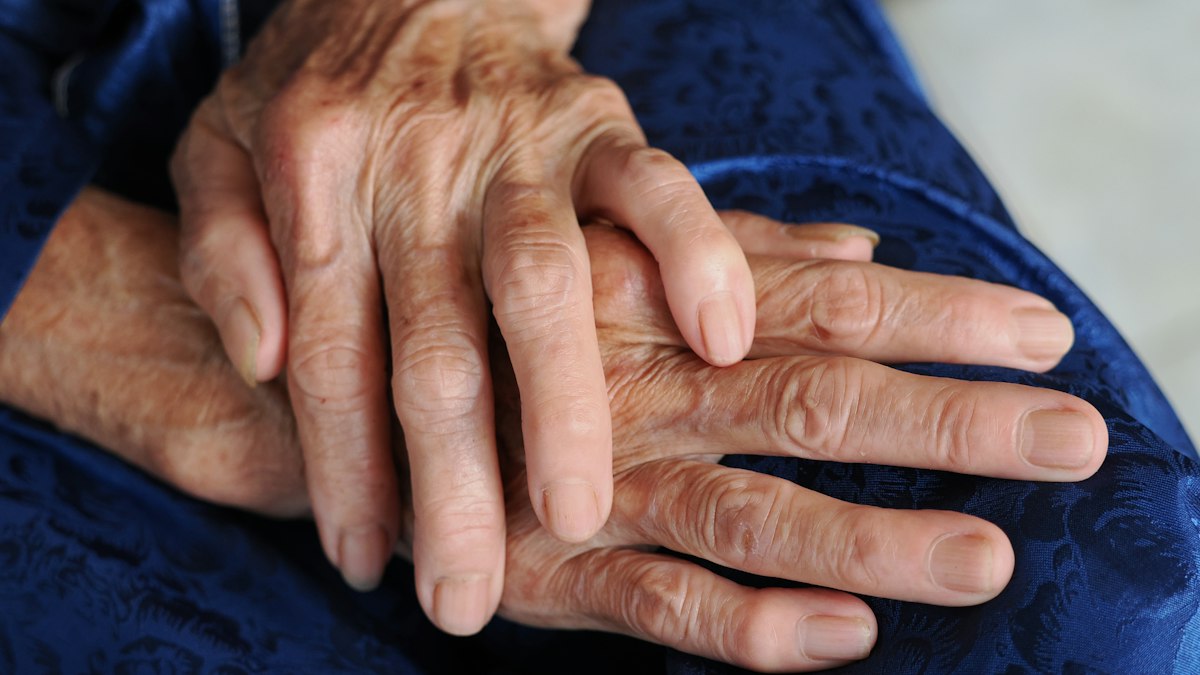
The final area you’ll finish with your morning set also hits the most joints. You can do this range-of-motion activity while lying down or at the side of the bed, but you will simulate making a fist with both hands before extending them like a frog’s webbed foot. Do ten of these cycles with a slow pace and make sure every joint gets a full range of motion if your body allows.
The only thing is, I don’t want this range-of-motion activity to be a practice in stress ball squeezes. Be mindful that your hand may clench if you go too hard and simply loosen the grip to prevent a tight fist. Executing this exercise correctly does a wonderful job of mobilizing the many joints in the fingers while simultaneously working the forearms.
The Evening Set
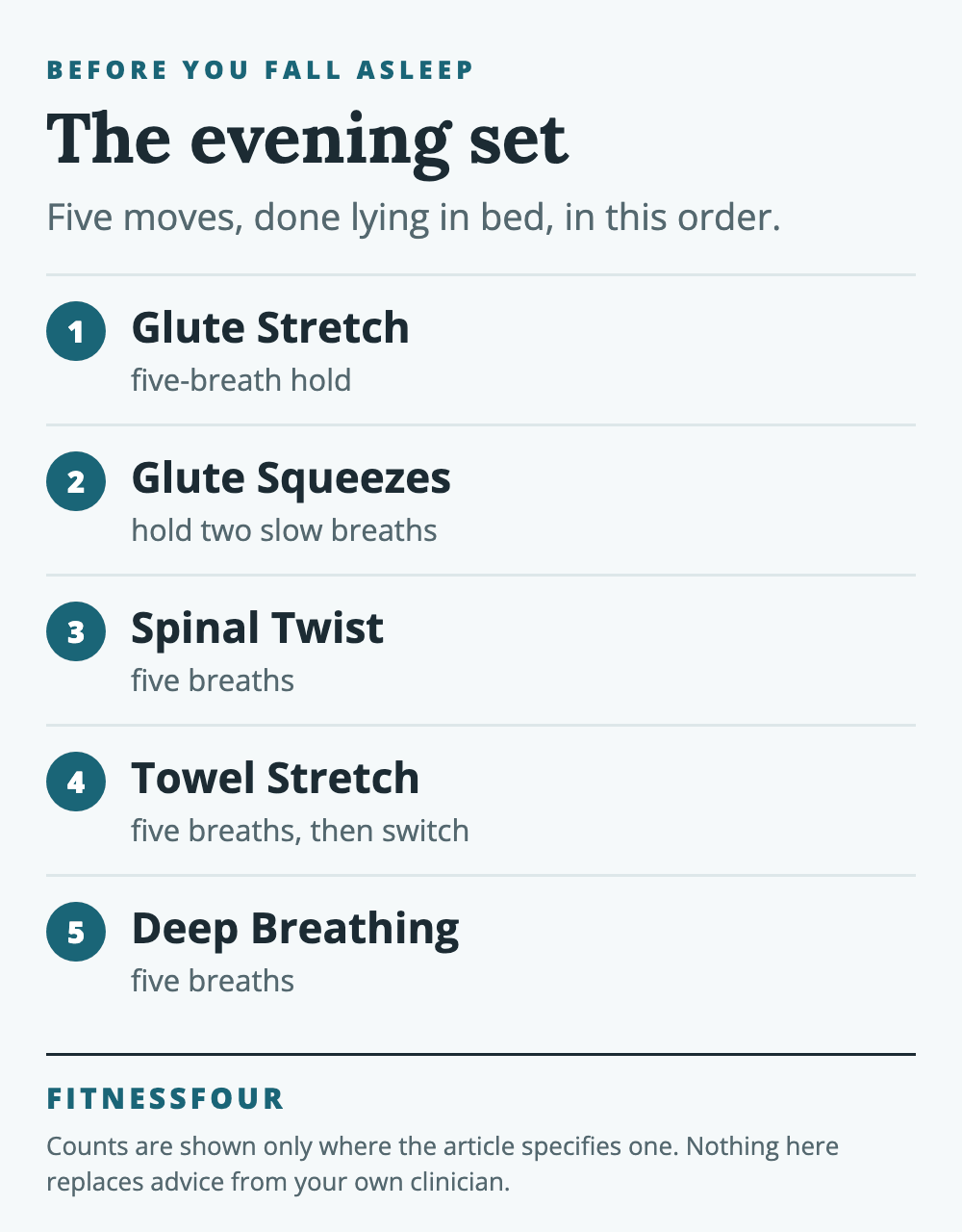
Taking the time right before you fall asleep is great for taking your mind from the day’s stressors. Unlike your morning routine, the evening mobility set is all about slowing things down to a crawl, taking the time to calm the muscles, and perform gentle stretches to encourage sleep ahead.
Glute Stretch
In my experience, clients enjoy this stretch because it feels good—and is a great way to calm the lower body. You start by lying on your back with the legs down on the bed and lift the right side up so the knee is near your torso. I like to have clients grab the shin to anchor the leg in place and use a five-breath hold count. Repeat on the other side and use the same technique as before. I believe in this stretch above all others because it is ideal to help relieve tension, calm the nerves, and is simply amazing for relaxing the body.
Glute Squeezes
Staying focused with more hip work, let’s look at glute squeezes—or clenches—right before you turn out the lights for the night. All you need to do is squeeze the buttocks and hold for two slow breaths before completely releasing. The contract and release rhythm can work wonders on the nervous system and I usually encourage this exercise before bed for anyone feeling stressed.
I am a big advocate for this gentle drill before bed because even though your glutes are a massive part of your posterior chain, they are secretly the unsung heroes of your stability, walking mechanics, and balance. Because these muscles have such a massive burden for your safety and functional independence, dedicating a minute or two before bed is a brilliant way to dissolve tension and quiet the body for the night.
Spinal Twist
The spine is the anchor for the entire body and is central to many of our movements. Despite having an incredible role in functional independence, many of my clients neglect spine work. Rest flat on your back with your legs extended and gently allow your right knee to go up towards your torso. This part is where you turn your leg across the body and remain here for five breaths.
I advise all of my senior clients to know their limitations when doing any spinal mobility exercises. Evening mobility stretches should already include lower effort and slower movements, but anyone who has a stiff back due to a condition should understand this limitation and only go to what the body allows.
Towel Stretch
I like to instruct my clients—young and older—to keep a towel or strap on the nightstand for this drill because the mattress is a perfect spot for a towel stretch. Kickstart this by stretching out flat and send your right foot in the air. Go ahead and loop the towel at the sole of that foot to make it secure and once you have a solid grip, steadily pull to where your range of motion ends.
You can create a variation if you have poor leg mobility just by lowering the towel to behind the upper thigh. Use a five breath count and change to the other side. The key to this stretch is knowing where you are at in your flexibility. Holding in this stretch can create a great deal of tension and I want this to be a light stretch that is not painful.
Deep Breathing
It is best to perform deep breathing using the stomach muscles, as this helps to provide diaphragm mobility. Lie in bed in a supine position, the head and neck in neutral positions, eyes closed, and legs flat down. Breathe in slowly through your nose and let the belly rise, then exhale by drawing your belly button down and in—as if you are trying to touch it to your spine beneath. Keep that slow rhythm going for five breaths.
I have instructed clients to use imagery when closing their eyes and picture a scene that brings joy. Adding this element to deep breathing—especially right before bed—helps to shed any negativity from your daily life and can melt stress.
What This Does and Doesn’t Do For Sleep

The most fundamental element in human nature is sleep and at some point or another we all struggle with sleep. I have instructed many clients—young and older—to pay close attention to their sleep patterns and to dedicate the time and attention to sleep—just as they would a workout. The evidence is promising and the subjective data is great, but the overall picture of what helps is still puzzling, which is why a healthcare provider may be needed.
Exercise has benefits for sleep and the data can back this up. A 2022 overview of systematic reviews and meta-analyses assessing exercise for sleep outcomes with older adults showed that exercise does have a positive effect on sleep quality in older adults. However, this overview looked at programs such as Tai Chi, Pilates, and Baduanjin Qigong, which are a bit more involved than bed mobility exercises, but these programs emphasize light movements.
A similar result was presented in a 2023 systematic review and meta-analysis. This review showed that exercise helped to lower the Pittsburgh Sleep Quality Index by about 2.5 points, but the interventions used in these older adults included yoga, walking, cycling, Pilates, and elastic bands—which are all not on the same level as gentle mobility. However, it is a positive note to see that exercise can have a powerful effect on sleep efficiency and quality.
The puzzling aspect is when the evidence is mixed, as in with this 2026 systematic review posted in Sleep Medicine Reviews. This review aimed to assess how slow, deep breathing before bed affects sleep quality. The data from this review showed that self-reported sleep quality and duration improved, but the objective data—actigraphy and sleep studies—was inconclusive.
Who Should Modify, and How
The morning and evening sets are purposefully light to give the body a chance to wake up and wind down. When a road block hits your way or if you have specific diagnoses or needs, you may need to tailor the sets to what your body allows. I have worked with an abundance of clients who had recent surgeries or procedures and realistically this should not get in the way of your continued well-being.
I instruct anyone who had a recent surgery or joint replacement to get clearance from a doctor or physical therapist before doing anything at home—especially home alone. With clearance, modifications for the morning and evening routine should include a reduced range of motion, lighter intensity, and holding for shorter durations. It all depends on what your body needs, but if you need to modify it for a health issue just know there are options that work.
Making it Stick
I have seen what exercise programs do to a wide range of clients—young and old—and the ones that stick are the ones that are the most manageable. Most of my experience being successful in having older women returning is to tailor the programs to be challenging, but not so hard that they can’t move the next day. Older women who experience any stiffness relief from these sets or improved sleep really are the ones who are most likely to keep it going. The time and effort given to the first and last parts of your day can be telling for your well-being and when joint pain and stiffness is harnessed, day-to-day wellness is likely to be affected in a more positive manner.